Why Your Shin Conditioning Routine Might Be Doing More Harm Than Good
Quick Answer: Repeatedly striking hard surfaces to ‘toughen’ shins can cause microfractures and periosteal damage rather than the intended adaptation — safer shin conditioning relies on gradual, moderate-impact training combined with adequate recovery time, which builds real bone density adaptation without the injury risk of aggressive traditional methods.
You’ve heard that real conditioning means striking something hard until it stops hurting. That approach can genuinely injure the bone rather than strengthen it — and the injury often doesn’t show up as obvious pain until much later.

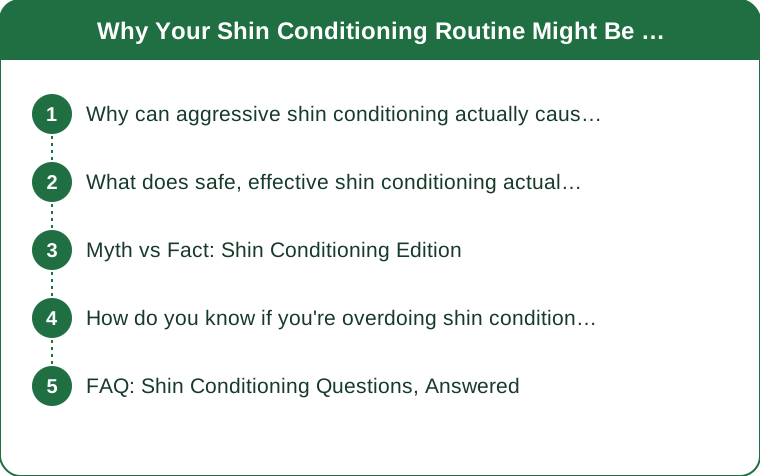
Why can aggressive shin conditioning actually cause damage?
Repeated hard impact on the shin, especially against unforgiving surfaces like bare wood or concrete-wrapped bags, can cause periosteal inflammation and microfractures in the bone’s outer layer faster than the bone can adapt and remodel. The numbness some traditional methods aim for isn’t a sign of successful toughening — it can actually reflect nerve or tissue damage from repeated trauma.
What does safe, effective shin conditioning actually look like?
Gradual, moderate-impact training on appropriately padded equipment — heavy bag work, pad work with a partner — done consistently over weeks and months, allows the shin bone to undergo genuine bone remodeling and density adaptation (a slower, more sustainable process similar to how any bone strengthens under progressive load). This is a months-to-years process, not something achieved through a few weeks of aggressive impact.

Myth vs Fact: Shin Conditioning Edition
Myth: Numbness in the shins is a sign of successful conditioning. Fact: Persistent numbness can indicate nerve irritation or tissue damage rather than beneficial adaptation.
Myth: You need to feel significant pain during conditioning for it to work. Fact: Effective bone adaptation happens through consistent, moderate, progressive loading — not through pushing into severe pain each session.
Myth: Rolling a bottle or striking wood repeatedly is a legitimate shortcut. Fact: These aggressive traditional methods carry meaningfully higher injury risk than gradual pad and bag training, without clear evidence of faster real adaptation.
How do you know if you’re overdoing shin conditioning?
Persistent swelling, bruising that doesn’t fully resolve between sessions, or sharp localized pain on the bone itself (as opposed to general soreness) are signs conditioning has outpaced recovery. Genuine bone adaptation should feel like gradually increasing tolerance over months, not consistent visible bruising after every session.
FAQ: Shin Conditioning Questions, Answered
How long does real shin conditioning actually take?
Meaningful adaptation typically develops over many months to a couple of years of consistent training, not weeks.
Should you train through shin bruising?
Generally no — training on a significantly bruised shin risks compounding damage before the bone has recovered; scaling back intensity temporarily is the safer approach.
Are shin guards a sign of weakness in training?
No — shin guards are standard, sensible protective equipment during sparring and pad work at every experience level, including among experienced competitors. This is general information, not medical advice.
TL;DR:
- Aggressive shin-toughening methods can cause microfractures and nerve damage, not just soreness
- Numbness during conditioning is a warning sign, not a marker of success
- Real bone adaptation happens gradually over months through moderate, consistent impact training
- Persistent bruising or sharp bone pain means recovery is being outpaced — scale back
Durable shins are built over months of consistent, moderate training — not a few weeks of striking something as hard as you can.
Keep Reading
This article is for general informational and styling purposes only. Fit, sizing, and product availability may vary.