7 Reasons Your Balance Fails After You Throw a Kick
Quick Answer: Post-kick balance failures are almost never a balance problem in isolation. They come from pivot mechanics, arm position, hip commitment, vision, and above all from having no planned recovery path. A Muay Thai roundhouse rotates a large fraction of your bodyweight around one foot, and if the pivot is incomplete or the return is unplanned, that momentum has to go somewhere. Here are the seven causes, ordered by how often they turn out to be the culprit.
You land the kick. Then you hop, square up, drop your hands, and spend two seconds getting your stance back.
In that two seconds you are available to be hit, and the fix is usually one of seven things.

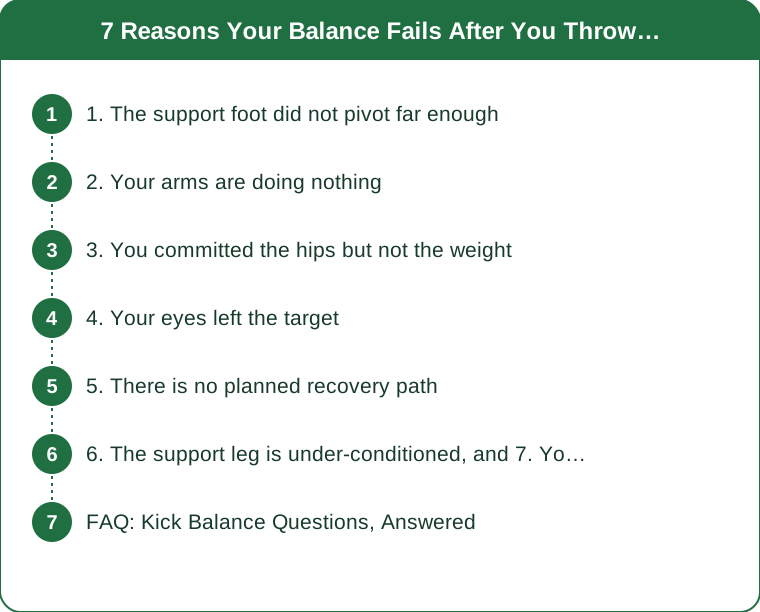
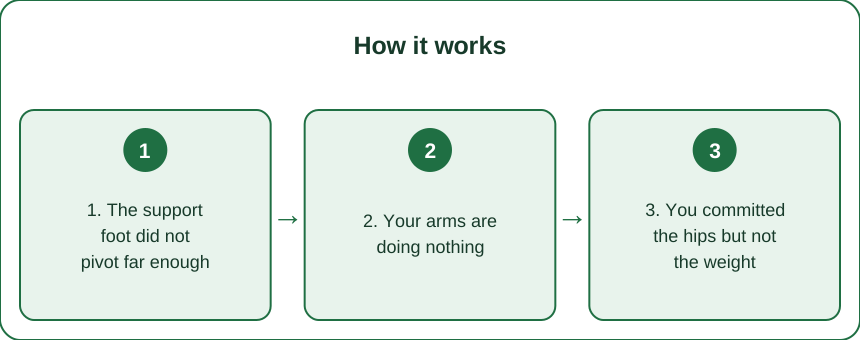
1. The support foot did not pivot far enough
The most common cause by a wide margin.
A Muay Thai roundhouse rotates the hips through a large arc, and the support foot has to rotate with them. The heel should end up pointing at, or past, the target. Roughly 90 degrees at minimum, often more.
If the foot stays planted, the rotation stops at the ankle and knee, which are not built to absorb it. The kick loses power and the body keeps rotating anyway, which is what pulls you off balance.
Drill it slowly. Throw at 30 percent power and check the heel position after every kick. Balance failures at full speed are almost always pivot failures at slow speed that you could not see.
2. Your arms are doing nothing
The arms are counterweights, and most people leave them out of the equation entirely.
In a correct right roundhouse, the right arm swings down and back as the leg comes through. That counter-rotation is what stops the upper body over-rotating with the hips.
What goes wrong: the arm stays up in guard, so the upper body follows the hips fully around, and you spin past the target. Or the arm swings wildly, dragging you further.
The compromise most coaches teach: the kicking-side arm drops and drives back in a controlled arc, and the lead hand stays up. You lose a little guard for a fraction of a second and you keep your feet.
Test: throw ten kicks with your arms folded across your chest and feel how much harder balance is. That difference is what your arms were supposed to be doing.
3. You committed the hips but not the weight
Half-commitment is worse for balance than full commitment.
A proper Muay Thai roundhouse involves stepping the support foot slightly out and forward as the kick launches, which puts your base under the rotation. A kick thrown from a completely static stance requires the hips to rotate around a base that is not aligned with the direction of travel.
Riders of this problem usually describe it as feeling like they are kicking across themselves. That is exactly what is happening.
The step is small, a few inches at an angle, and it does two things: it aligns the base with the arc, and it closes distance, which is why the kick also lands harder.
If you are told to step out and it feels like telegraphing, the step is too big. It should happen as part of the kick, not before it.

4. Your eyes left the target
Vision drives balance more than most people realise, and it degrades in a specific pattern.
When the kick starts, many people look at their own leg, at the floor, or away entirely as the head turns with the rotation. Losing the visual reference removes the main input the vestibular system is checking against.
The result is the specific disoriented version of a balance failure, where you are not just off balance but momentarily unsure which way you are facing.
Keep the eyes on the target through the kick and through the recovery. On a full-rotation kick where the head has to come around, the instruction is to find the target again as fast as possible rather than to never lose it.
This gets much worse when tired, which is why balance in round four is worse than balance in round one even when the mechanics are unchanged.
5. There is no planned recovery path
The kick has a plan. The return usually does not, and that is where most of the two seconds go.
Every kick should have a decided default return: back to stance the way you came, or continuing the rotation through to a switched stance. Both are legitimate. Not deciding is what produces the hop.
What happens without a plan is that the body starts returning the way it came, the momentum is still going the other way, and the two compete. You land in a compromise position, square, with weight on the wrong foot.
Pick one and drill it. For most people, recovering back to the original stance is the default and the through-rotation is the option for when the kick misses or the momentum is too great to stop.
How do I drill this?
Throw kick, recover, and immediately throw a jab or a check. Adding a required next action forces the recovery to end somewhere usable rather than wherever it happens to end.
6. The support leg is under-conditioned, and 7. You are kicking beyond your range
6. Support leg conditioning. The standing leg does isometric work through the whole kick, stabilising against a large rotational force. Calves, ankle stabilisers, glute medius and the whole foot are all involved, and they fatigue faster than the kicking leg because they work on every single kick, including the ones from the other side.
Balance that is fine for twenty kicks and gone by forty is a conditioning problem, not a technique problem. Single-leg work addresses it directly: single-leg calf raises, single-leg Romanian deadlifts, and simply standing on one foot with the eyes closed, which specifically trains the input you lose in point four.
7. You are kicking from beyond your range
The last one and the easiest to miss, because it feels like a technique failure.
If the target is slightly too far away, you unconsciously reach for it. Reaching means leaning the upper body away from the base, extending further than the pivot supports, and pushing the centre of mass outside the support foot. The kick lands weakly, if at all, and you fall through it.
The tell is that your balance is fine on the bag at close range and poor on pads or in sparring, where distance varies. Fix the distance rather than the kick. Step in with the support foot, or throw a different weapon. A teep or a knee at the range where a roundhouse would be a reach is both better balance and better fighting.
This is general information, not coaching or medical advice. Learn techniques with a qualified instructor.
FAQ: Kick Balance Questions, Answered
Should I practise kicks on an unstable surface to improve balance?
Generally no. Sport-specific balance transfers best from practising the actual movement. Single-leg strength work on stable ground is more useful than balance boards for this.
Why is my balance so much worse on my weak side?
Usually pivot range and support-leg conditioning, both of which are simply less practised. It responds quickly to deliberate reps on that side.
Does kicking with shoes on change anything?
Yes, and if you train barefoot, do not test yourself in trainers. Grip is different, so the pivot is different, and a foot that cannot rotate will send that rotation to your knee.
Is falling after a kick ever acceptable?
In training it is feedback. In sparring or a fight it is a score against you and an exposure, which is why recovery gets drilled as its own skill rather than treated as an afterthought.
TL;DR:
- Incomplete support foot pivot is the most common cause. The heel should point at or past the target.
- Arms are counterweights. The kicking-side arm drops and drives back, or the upper body over-rotates.
- Step the support foot out slightly so the base aligns with the arc, and commit fully rather than halfway.
- Keep the eyes on the target, and expect this to degrade with fatigue.
- Decide the recovery path in advance, back to stance or through the rotation. Not deciding causes the hop.
- Condition the support leg with single-leg work, and stop kicking from beyond your range, which is what produces the reach.
Drill kicks at 30 percent power and watch the heel. Nearly every balance failure you have at full speed is visible, and fixable, at that pace.
This is general information, not coaching or medical advice.
Keep Reading
This article is for general informational and styling purposes only. Fit, sizing, and product availability may vary.