7 Reasons Your Shots Land on Pads But Never in Sparring
Quick Answer: Pad work trains the shot; sparring tests the setup, the timing, and the read. On pads the target comes to you, holds still, and tells you what is coming next. Remove those three gifts and technique that looked clean has nothing to attach itself to.
Your coach says your roundhouse is one of the best in the gym.
You have never landed it clean on a moving person.
Here are the seven gaps between those two facts, and what closes each one.
This is general information, not medical advice.

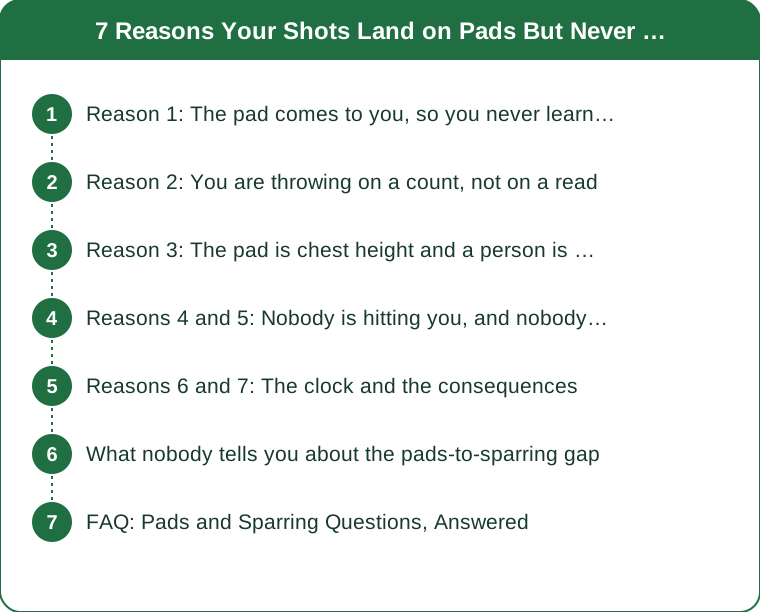
Reason 1: The pad comes to you, so you never learned to close distance
A pad holder covers the last portion of the distance for you. They step in, present the target at the exact range your technique works from, and absorb the shot.
That means the hardest part of striking — getting to a range where your weapon is live, against someone actively preventing it — is the part pad work removes entirely.
In sparring nobody closes it for you. You are either in range and being hit, or out of range and missing, and the transition between those is the actual skill.
What closes it: ask your pad holder to stop stepping in. Make them hold at a fixed spot and require yourself to cover the ground. Better still, ask them to move backward at random intervals so the range is never given to you twice in the same place.
Why does my range feel fine on the bag then?
The bag also does not move away. Both tools train the shot at a range you selected in advance, which is the range you rarely get in sparring.
Reason 2: You are throwing on a count, not on a read
Combinations get drilled as sequences — one-two-kick, one-two-elbow — and the pads confirm the sequence by appearing in exactly that order.
What you are rehearsing is a motor pattern with a fixed trigger: the coach calling the number. In sparring the trigger has to come from your opponent, and if you never trained that link, the combination has nothing to start it. So you either throw on your own internal count and get countered, or you wait for a certainty that never arrives.
What closes it: pad rounds where the holder gives no calls and instead shows openings — dropping a hand, stepping to one side — and you respond. It is slower and messier and it builds the missing half.
The symptom to watch for: if your best combination is the one your coach calls most often, it is the call you learned, not the opening.
Reason 3: The pad is chest height and a person is not
Pad holders naturally hold at a comfortable, consistent height — usually right where a shot feels satisfying to throw.
A sparring partner presents a head that moves vertically as well as laterally, a body that turns away, and a lead leg that is sometimes there and sometimes not. Your technique was calibrated to a target with one height and one angle.
This shows up most on the roundhouse to the body, which lands beautifully on a held pad and slides off a turning ribcage, and on the cross, which finds a stationary pad and misses a head that dipped four inches.
What closes it: insist on varied heights and angles during pad work, and spend real time on the bag hitting it at levels other than the one that feels best. Then spar with a specific instruction to land one shot at each of three heights.

Reasons 4 and 5: Nobody is hitting you, and nobody is trying to
Reason 4: Your defense was never in the loop
On pads you throw from a stance you can hold indefinitely, because nothing is coming back. The guard drops, the chin lifts, and the weight sits forward — none of which costs anything.
Sparring charges for all three immediately. The technique itself may be fine; what fails is that it was built without any requirement to stay defensively sound during and after it.
What closes it: pad rounds where the holder counters. Every time you finish a combination, they throw one back at 30% and you have to be in position for it. This changes technique fast, because it makes recovery part of the movement rather than an afterthought.
Reason 5: Adrenaline changes what your body can do
Even light sparring raises heart rate and stress hormones, and fine motor control degrades as arousal rises. The technique you own at 60% of maximum heart rate is not the technique available at 85%.
This is why people describe forgetting everything in their first rounds. Nothing was forgotten — the retrieval got harder under load.
What closes it: train at elevated heart rate deliberately. Pad rounds after conditioning work, sparring rounds that start immediately after a hard round rather than from rest. The goal is to build technique that survives the physiological state you will actually use it in.
Reasons 6 and 7: The clock and the consequences
Reason 6: Pad rounds have no consequence for being predictable
If you throw the same combination twelve times on pads, the pads accept it twelve times. A sparring partner reads it by the third and starts countering the setup.
This is the most fixable and most commonly missed gap. Most people have two or three patterns they default to under pressure, and they cannot see them from the inside.
What closes it: ask a training partner to tell you what you always do. They know. Then run rounds where the specific instruction is that you may not throw your favourite shot at all.
Reason 7: You are managing a round, not a repetition
Pad work is dense — shots come continuously and the round is a workout. Sparring has rhythm, pauses, resets, and periods of nothing happening while both people look for something.
People who only do pads tend to spar at pad pace, empty the tank in ninety seconds, and spend the rest of the round surviving. That is not a fitness problem so much as a pacing one, and pad work actively trains the wrong pace.
What closes it: spar longer rounds at lower intensity rather than short intense ones, and practise doing nothing on purpose — moving, looking, resetting — without feeling obliged to fill the space with output.
What nobody tells you about the pads-to-sparring gap
The gap is normal and it is not a sign you are behind. Almost every striker goes through a period where their pad work looks far better than their sparring, because pad work improves faster. It is a cooperative task with immediate feedback, and it should improve faster.
The people whose sparring matches their pads usually spar more, not better. There is no drill that substitutes for the specific experience of a resisting opponent. Technical work builds the tools; only sparring builds the selection.
Light sparring transfers better than hard sparring. At high intensity most people revert to their two most reliable shots and stop learning anything. Rounds at 40 to 50% where you are explicitly trying new things build the skill that hard rounds only test. Gyms that spar hard every week tend to produce people who are durable rather than technical.
Your coach already knows. Ask specifically: what do I do on pads that will not work on a person? Most coaches have a precise answer and are waiting for someone to want it.
Give it rounds, not weeks. The usual timeline for pad technique starting to appear in sparring is measured in dozens of rounds. If you spar once a fortnight, the arithmetic explains more than your technique does.
FAQ: Pads and Sparring Questions, Answered
Should I do less pad work?
No — pad work builds the technique that sparring selects from. The issue is the ratio and the type, not the tool. Adding uncooperative elements to pad rounds is more useful than cutting them.
How often should a beginner spar?
That depends on your gym and your coach, but once or twice a week at controlled intensity is a common structure. What matters more is that it is light enough to experiment in.
Why do I gas out so much faster sparring than on pads?
Partly pacing, partly tension. Beginners hold far more muscular tension than needed — clenched shoulders, gripped fists, held breath — and tension is metabolically expensive. Breathing out on every strike is the single most effective fix.
Is it normal to freeze completely?
Common, and it fades. Freezing is usually too many decisions at once; reducing the decision set helps. Give yourself one instruction per round — only jab and move, only work the body — and the freeze generally resolves.
Should I spar with people better than me or similar?
Both, for different reasons. Better partners control the round and let you try things safely. Similar partners let you win exchanges, which is where confidence in a technique actually forms. Mostly-better partners is the trap: you learn to survive rather than to strike.
TL;DR:
- Pads give you range, timing, height, and no consequences — sparring removes all four.
- Have your holder stop stepping in, stop calling numbers, and start countering.
- Train at elevated heart rate so technique survives the state you will use it in.
- Ask a partner what you always do; your defaults are invisible from the inside.
- Light sparring transfers more than hard sparring, and rounds matter more than weeks.
The gap between your pads and your sparring is not a flaw in your technique. It is the part of the skill that pads were never able to teach, and it closes with the specific practice that builds it.
This is general information, not medical advice.
Keep Reading
This article is for general informational and styling purposes only. Fit, sizing, and product availability may vary.