Why Your Kicks Feel Noticeably Weaker on Your Off Side (and How to Close the Gap)
Quick Answer: A weaker off-side kick is caused by far less repetition on that side during normal training (most drilling defaults to the lead-power-side pattern), not a physical limitation. Deliberately doubling off-side reps for several weeks closes most of the gap.
Every Muay Thai gym has students who kick beautifully on one side and stiffly on the other. The physical explanation is almost always simpler than people assume.

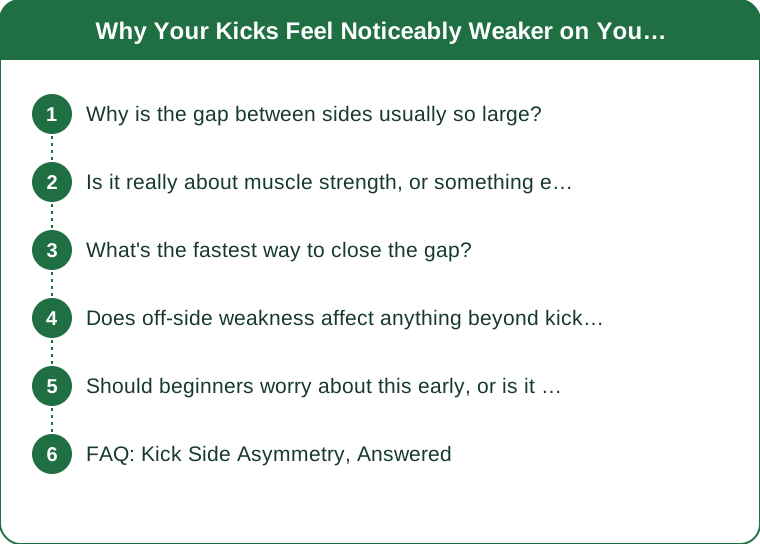
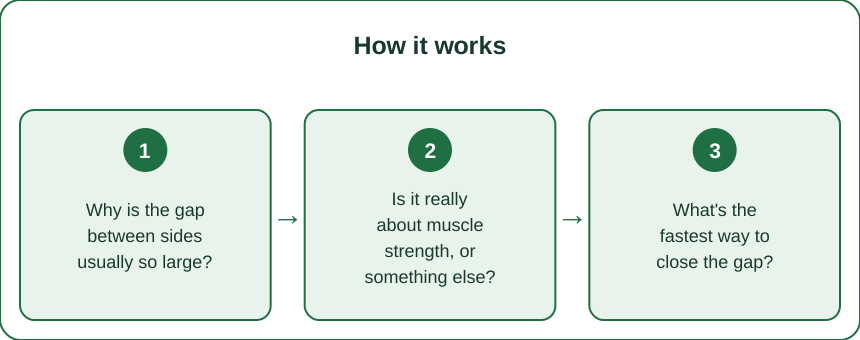
Why is the gap between sides usually so large?
Most training naturally biases toward the dominant/power side — pad rounds, bag work, and even warm-ups tend to default there unless a coach or the student deliberately balances it. Over months, this repetition gap compounds into a noticeable strength and coordination difference, even though the muscles themselves aren’t meaningfully weaker.
Is it really about muscle strength, or something else?
Mostly motor pattern familiarity, not raw muscle strength — the hip rotation, balance, and chambering sequence of a kick is a coordinated skill, and skills that are under-practiced feel clumsy and weak even when the underlying muscles are perfectly capable. This is why off-side kicks often improve fast once given deliberate attention, faster than pure strength gaps would allow.
What’s the fastest way to close the gap?
Deliberately reversing the normal ratio for several weeks — doing 60-70% of kick reps on the weaker side instead of the usual even or dominant-biased split — is the most commonly recommended fix among coaches, since the issue is a repetition deficit that responds directly to reversing the imbalance.

Does off-side weakness affect anything beyond kick power?
Yes — a weak off-side kick often means a weak off-side check (defensive block) too, since both movements share the same hip mechanics. Students who only notice the offensive power gap are often also carrying an underappreciated defensive vulnerability on that same side in sparring.
Should beginners worry about this early, or is it normal?
It’s completely normal early on and not worth stressing over in the first few months — the asymmetry is expected while the skill is new. It’s worth deliberately addressing once a student has enough base technique that the gap becomes a limiting factor in sparring or pad work, typically a few months in.
FAQ: Kick Side Asymmetry, Answered
How long does it typically take to close a noticeable side gap?
Most students see meaningful improvement within 4-6 weeks of deliberately biased practice, though full parity can take longer depending on how large the initial gap was.
Should you switch your fighting stance to fix this?
No — stance and dominant side aren’t the problem; the fix is added repetition on the weaker side within your existing stance, not switching stances.
Can shadow practice at home help close the gap?
Yes — slow, deliberate shadow kicks on the weak side, focused on hip rotation and balance rather than speed, are a low-risk way to add extra reps between gym sessions.
TL;DR:
- Off-side kick weakness is mostly a repetition gap, not a strength limitation
- Kicks are a coordinated skill, so under-practiced sides feel clumsy even with capable muscles
- Deliberately biasing 60-70% of reps to the weak side for several weeks closes most of the gap
- A weak off-side kick often means a weak off-side check too, worth checking in sparring
The gap isn’t permanent — it’s a training default that responds quickly once you deliberately flip the ratio for a few weeks.
Keep Reading
This article is for general informational and styling purposes only. Fit, sizing, and product availability may vary.