7 Reasons Your First Sparring Round Is Always the Worst One
Quick Answer: Round one suffers from incomplete warm-up, an adrenaline spike that narrows vision and burns energy, no read on your partner yet, and breathing that has not settled. By round three all four have resolved, which is why the same person looks like a different fighter. Fix it with a longer specific warm-up, three rounds of shadowboxing at rising intensity, deliberate exhaling, and treating round one as reconnaissance rather than competition.
You spend round one getting hit by things you would normally see, and round three feels like you finally showed up.
Here is what is actually happening in those first three minutes, and what changes it.

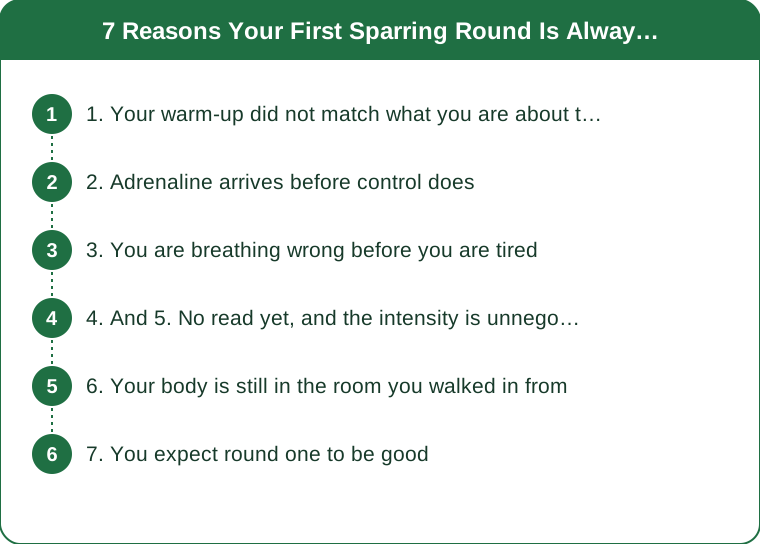
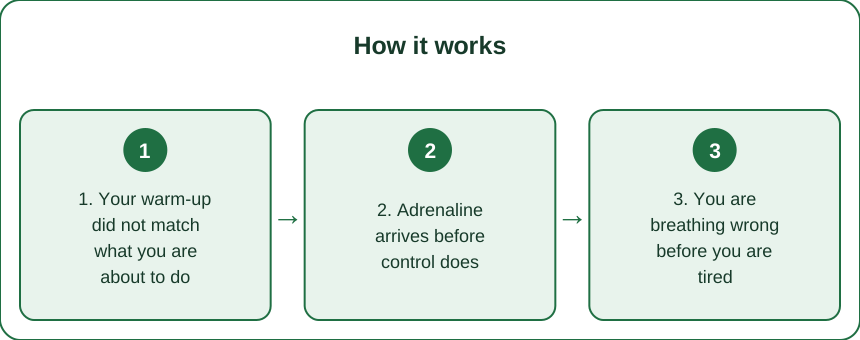
1. Your warm-up did not match what you are about to do
General warm-ups do not prepare specific movements. Skipping rope and light bag work raise your temperature but do not rehearse the reactive, unpredictable patterns sparring demands.
Reaction time improves with specific rehearsal, not just with elevated heart rate. Your nervous system needs to have already run the pattern - slip, check, counter - before it can run it under pressure.
Fix: three rounds of shadowboxing at rising intensity before gloves go on, with the last round including defensive movement, level changes, and checks at close to sparring speed.
Add partner drills at 30 percent if the class structure allows, which is the single most effective bridge between warming up and sparring.
2. Adrenaline arrives before control does
The adrenaline spike peaks in the first minute and produces exactly the effects you do not want: elevated heart rate, tunnel vision, fine motor degradation, and time distortion. This is a normal stress response, not nerves in the pejorative sense.
Tunnel vision is the expensive part. Peripheral vision narrows under stress, which is why round-one kicks arrive apparently from nowhere and round-three kicks are visible.
Fine motor control degrades first, which is why your hands feel clumsy and your combinations come apart in a way they never do on pads.
Fix: extended exhales before the round starts. Four breaths with a four-count inhale and an eight-count exhale measurably reduces the sympathetic spike. Do it while gloving up rather than in the ring.
3. You are breathing wrong before you are tired
Breath-holding during exchanges is nearly universal in round one, and it produces oxygen debt within the first thirty seconds. That debt then persists through the entire round.
The result feels like poor cardio and is not. You are not unfit at minute one; you are holding your breath through every exchange and paying for it immediately.
Fix: exhale audibly on every strike, which is the standard Muay Thai cue and exists for exactly this reason. If you can hear yourself, you are breathing.
Between exchanges, exhale longer than you inhale. Recovery in the gaps is what makes round three feel manageable, and it is a trainable habit rather than a fitness quality.

4. And 5. No read yet, and the intensity is unnegotiated
4. You have no information about your partner
Round one is where you learn their timing, reach, favorite lead, and rhythm. Everything you do before you have that read is guesswork, and it is why the round feels reactive rather than deliberate.
The fix is to reframe it deliberately: round one is reconnaissance. Move more, throw less, and spend it gathering information. Fighters who treat round one as a scouting round consistently look better in rounds two and three - it is a decision rather than an ability.
5. Nobody agreed on the intensity
Most bad first rounds come from a mismatch in expectation. One person is going 40 percent and the other is at 70, and the first thirty seconds are spent discovering that through contact.
The fix takes five seconds and almost nobody does it: agree before you start. Say a number, name what you are working on, and confirm what is off the table. It changes the entire round, and it is the single highest-return habit in this whole list.
6. Your body is still in the room you walked in from
Attention takes time to transfer. You arrived from work, traffic, or a difficult day, and cognitive residue from that persists into the first round in a measurable way.
It shows up as late reactions and poor decisions rather than as poor technique - you see things a beat after they happen.
Fix: a deliberate transition ritual. Two minutes of something repetitive and physical - skipping, breathing, wrapping hands slowly with attention - before you start the warm-up proper.
Phone away well before gloves go on, since a message read three minutes before sparring occupies more attention in round one than anyone wants to admit.
7. You expect round one to be good
The expectation itself makes it worse. Getting caught in the first minute produces frustration, frustration produces tension, and tension produces exactly the stiffness that causes more of it.
Elite fighters do not have great first rounds either. They have a plan for them, which usually means movement, range-finding, and low commitment until the read is established.
Fix: set a round-one goal that is not about performance. Land three jabs, check three kicks, throw nothing above 50 percent. A process goal is achievable in a round where an outcome goal is not.
So what does the whole fix look like?
Three rounds of rising-intensity shadowboxing, four extended exhales while gloving up, an agreed intensity with your partner, audible breathing on every strike, and round one treated as reconnaissance. That is five changes, all of which happen before or during the first three minutes, and none of which requires being fitter or more skilled than you already are.
TL;DR:
- General warm-ups do not rehearse reactive patterns - three rounds of rising-intensity shadowboxing is what prepares round one.
- The adrenaline spike peaks in the first minute, narrowing peripheral vision and degrading fine motor control.
- Breath-holding through early exchanges creates oxygen debt that lasts the whole round; exhale audibly on every strike.
- You have no read on your partner yet - treat round one as reconnaissance rather than competition.
- Agree the intensity out loud before you start. Five seconds, and it is the highest-return habit on the list.
Elite fighters do not have great first rounds either. They have a plan for them.
Keep Reading
This article is for general informational and styling purposes only. Fit, sizing, and product availability may vary.