7 Reasons Your Clinch Falls Apart Against Taller Opponents
Quick Answer: Against a taller opponent, inside position matters more than strength, and the fastest fix is getting your hands inside their arms before the grip contest starts. Most losses in the clinch are decided in the first half second, not in the wrestling that follows.
You can hold your own against people your size and get dominated by anyone with three inches on you. It feels like a strength gap. Almost always it is a timing and entry gap, and both are trainable.

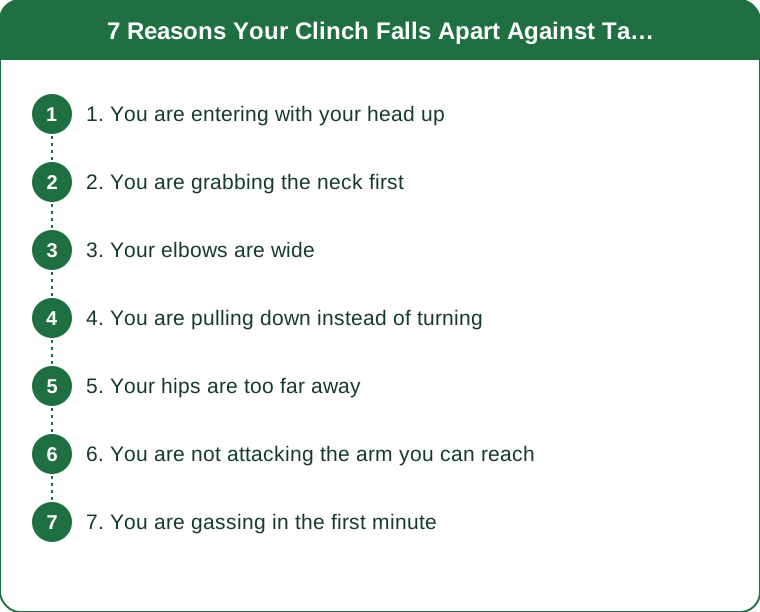
1. You are entering with your head up
Walking into the clinch upright hands a taller opponent the exact fight they want. Their reach and leverage advantage is maximized when both fighters are vertical.
Entering with a lowered level and forward pressure changes the geometry. You want your head under their chin line before your hands ever arrive.
Drill it slowly: from range, step in with a level change of 4-6 inches, plant your forehead against their chest, and only then work the hands. Ten minutes a session for two weeks changes the entry permanently.
2. You are grabbing the neck first
The double collar tie is the destination, not the entry. Reaching for it directly from range gives a taller opponent a free frame, because their arms get inside yours on the way.
Enter on the biceps or the inside of the elbow instead. Control there, then walk the hands up.
This is the single most common technical error among shorter clinch fighters, and it is also the easiest to fix, because it is a decision rather than an attribute.
3. Your elbows are wide
Wide elbows are an open door. A taller opponent slides their arms inside, gets a frame on your chest, and now you are holding their head from a foot away, which is worthless.
Keep the elbows tight to your own ribs through the entry. Narrow beats wide when both fighters want the inside.
The cue that works: imagine carrying two books under your arms until the moment your hands land. If you drop a book, your elbows flared.

4. You are pulling down instead of turning
Pulling a taller head straight down is a strength contest you will lose, because their posture chain is longer and they can simply straighten.
Turn them instead. Off-balance in a circle, not a line. A quarter turn breaks posture far more efficiently than a vertical pull, and it costs a fraction of the effort.
Think of it as steering rather than lifting. The moment their feet cross or their weight lands outside their base, the height advantage disappears entirely.
5. Your hips are too far away
Distance in the clinch is measured at the hips, not the hands. Many shorter fighters get good hand position and then stand a foot back, which gives the taller fighter room to knee.
Close the hips. Hip-to-hip contact removes their knee space and gives you a pivot point for turns.
It feels uncomfortably close if you are used to fighting at range, and that discomfort is the point. Every inch you leave is an inch of leverage they get for free.
6. You are not attacking the arm you can reach
Against a taller opponent you often cannot get both hands to the neck. That is fine, and treating it as failure is what stalls people.
One collar tie plus one arm control is a completely functional position. It opens short elbows, knee entries on the controlled side, and turning attacks.
Stop chasing the double and start winning with the asymmetric grip. Many high-level fighters live in this position by choice.
7. You are gassing in the first minute
Clinching is enormously expensive, and against a taller opponent the temptation is to muscle everything, which triples the cost.
Grip strength and forearm endurance are trainable and specific. Two sets of 60-second heavy bag neck-grip holds, twice a week, changes round-three clinch noticeably within a month.
More importantly, learn to rest in position. Once you have inside control and hip contact, you can breathe. Fighters who never learn this treat every second of clinch as maximum effort and fade predictably.
Quick FAQ
Is being shorter actually a disadvantage in the clinch? Less than people assume. A lower center of gravity and shorter levers are genuine advantages once you get inside; the difficulty is entirely in the entry.
How often should I drill clinch? Twice a week of dedicated clinch work, 15-20 minutes, moves things faster than adding it to the end of every session when you are already tired.
Should I lift for clinch strength? Rows, carries, and grip work transfer well. Chasing general size does not transfer nearly as much as position and timing do.
This is general information, not medical advice. Neck and shoulder pain from clinch work that persists past a few days deserves a professional look.
TL;DR:
- Enter with a level change and forehead contact before the hands arrive
- Grab biceps or inside elbow first, never the neck directly
- Turn the opponent rather than pulling down, and close to hip-to-hip
- One collar tie plus arm control is a winning position, not a consolation
Pick one item from this list and drill only that for two weeks. The entry level change is the highest-yield place to start, because everything downstream of a bad entry is damage control.
Keep Reading
This article is for general informational and styling purposes only. Fit, sizing, and product availability may vary.