7 Reasons Your Muay Thai Kicks Feel Noticeably Weaker Than They Did a Month Ago
Quick Answer: Weakening kicks over a few weeks are usually explained by one or more of seven factors — accumulated hip flexor and glute fatigue, subtle form drift, inadequate recovery between hard sessions, dehydration affecting muscular power output, worn or overly cushioned shin conditioning routines that dull sensory feedback, a stalled or plateaued core rotation, and simple overtraining — rather than any sudden loss of actual skill or strength.
A kick that’s lost its snap over the course of a month usually hasn’t lost any underlying skill — something in the surrounding training pattern has shifted, and it’s almost always one of a specific, checkable set of causes.

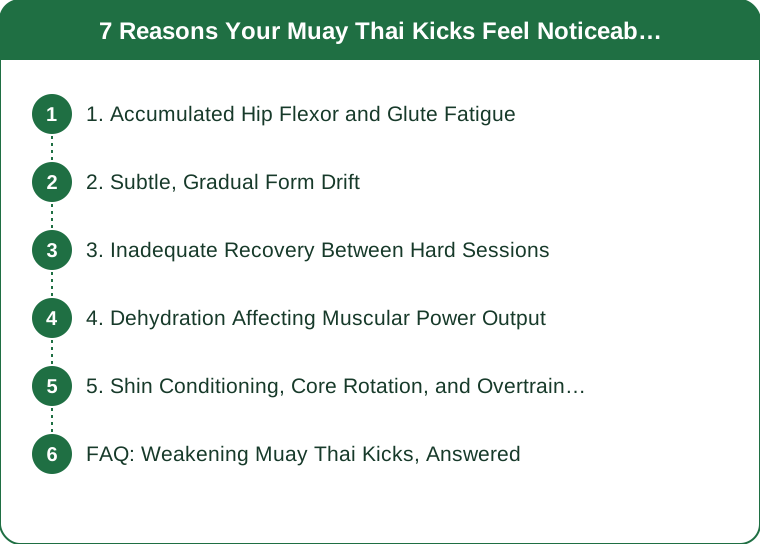
1. Accumulated Hip Flexor and Glute Fatigue
Kick power originates primarily from hip rotation and glute drive, not the leg swing itself, and these muscle groups accumulate fatigue over weeks of regular training that isn’t always consciously noticed day to day. Chronically fatigued hip flexors and glutes produce measurably less rotational power even when the kicking technique itself hasn’t changed at all.
2. Subtle, Gradual Form Drift
Technique tends to drift gradually under fatigue or without regular coaching correction, and small changes — a slightly earlier hip rotation, a dropped guard hand affecting balance, a shortened chamber — compound into a noticeably less powerful kick over several weeks even though no single session felt like a technique breakdown.
3. Inadequate Recovery Between Hard Sessions
Muscular power output is measurably reduced under accumulated, unresolved fatigue, and a training schedule that’s gradually increased in frequency or intensity without a proportional increase in recovery time or sleep can quietly erode kick power over weeks, showing up as a general flatness rather than one specific bad session.

4. Dehydration Affecting Muscular Power Output
Even mild, chronic dehydration measurably reduces muscular power and contraction force, and this effect compounds over a training block if hydration habits have quietly slipped, which is common during busy or stressful stretches. This is a frequently overlooked factor precisely because it develops gradually rather than showing up as an obvious, single-session problem.
5. Shin Conditioning, Core Rotation, and Overtraining
Shin Conditioning Routines That Dull Sensory Feedback
Overly aggressive or frequent shin conditioning can lead to reduced sensory feedback and nerve sensitivity in the shin over time, which paradoxically can make a kick feel less powerful and less precisely landed, even if the actual force delivered hasn’t dropped as much as it feels like it has.
A Stalled or Plateaued Core Rotation
Core rotational strength directly transfers into kick power through the kinetic chain connecting hip drive to the striking leg, and if core-specific training has stalled or dropped out of a routine focused mainly on pad work and sparring, kick power can plateau or even regress despite consistent kicking practice itself.
General Overtraining Without Enough Deload
A training block that’s been consistently hard for many weeks without a deliberate lighter or deload week can produce a general, systemic power reduction across all strikes, not just kicks specifically, which is the body’s broader signal that accumulated fatigue has outpaced recovery capacity.
FAQ: Weakening Muay Thai Kicks, Answered
How can someone tell which of these seven factors is the actual cause?
Reviewing recent training logs for sleep, hydration, and session frequency changes is a good starting point, and filming a kick on video to check for form drift against an earlier video is one of the more reliable ways to isolate a technique-specific cause.
Is a deload week actually likely to restore kick power, or does that just lose training momentum?
A properly structured deload week (reduced volume and intensity, not complete rest) very often restores power specifically because it allows accumulated fatigue to clear — many athletes report their hardest strikes feeling noticeably sharper immediately after a deload, not weaker from the reduced training.
Should shin conditioning be reduced if it’s suspected as a contributing factor?
Reducing frequency and intensity of shin conditioning specifically, rather than stopping it entirely, is generally the more balanced approach — sensory feedback in the shin often improves within a few weeks of reduced conditioning frequency.
TL;DR:
- Weakening kicks over weeks usually trace to accumulated fatigue, form drift, or recovery gaps — not lost skill
- Hip flexor and glute fatigue, dehydration, and core rotation plateaus all independently reduce kick power
- Aggressive shin conditioning can dull sensory feedback, making kicks feel weaker than they actually are
- A proper deload week often restores power more effectively than pushing through the flat feeling
A kick that’s lost its snap over a month is a solvable pattern, not a lost skill — checking these seven factors usually points directly to the fix.
Keep Reading
This article is for general informational and styling purposes only. Fit, sizing, and product availability may vary.