Muay Thai Shin Conditioning: What Actually Works and What Is Gym Folklore
Quick Answer: Shin conditioning works through two slow adaptations: bone remodeling — repeated sub-injury impact stimulates the shin to lay down denser bone over months — and nerve desensitization, where regular impact recalibrates how loudly your shins report contact. Both come from one source: progressive rounds on heavy bags and pads, hundreds of kicks a week at tolerable intensity. What does not work: rolling sticks or bottles down your shins (bruises soft tissue, conditions nothing), kicking trees or concrete (injury cosplay), and deliberately kicking harder than your current shins tolerate. The bag is the program; time is the secret ingredient.
Every beginner’s first pad session ends the same way — shins on fire, a limp on the stairs, and a YouTube rabbit hole of fighters rolling glass bottles down their tibias. The folklore is colorful; the physiology is boringly clear. Your shins will harden dramatically in a year of ordinary training, and almost everything marketed as a shortcut either does nothing or sets the process back.

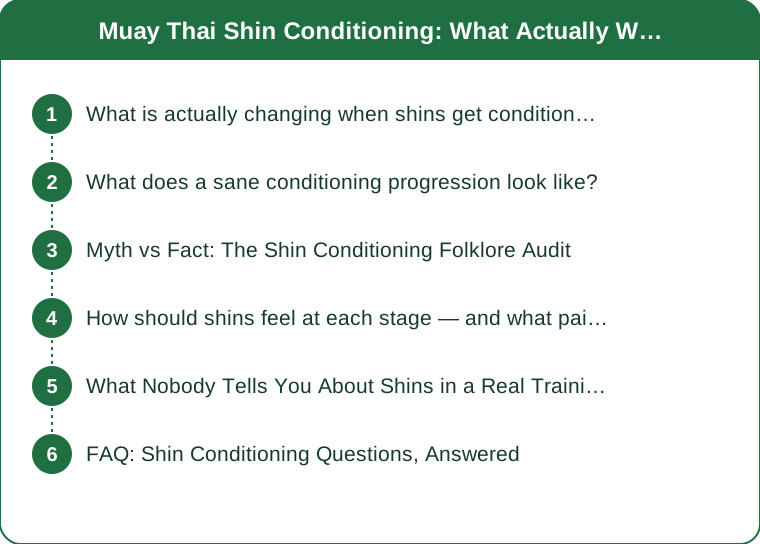
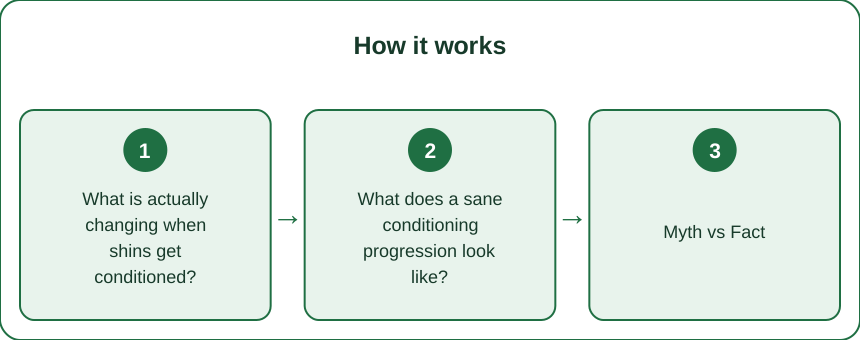
What is actually changing when shins get conditioned?
Two systems adapt on two different clocks.
The bone itself remodels. Bone is living tissue that responds to mechanical stress by reinforcing — the same principle (Wolff’s law) that gives tennis players denser racquet-arm bones and runners denser leg bones. Repeated impact within tolerance microscopically stresses the tibia, and over weeks-to-months of repair cycles the bone rebuilds denser and better organized along the stress lines. Studies of experienced strikers show measurably higher shin bone density than untrained controls. The critical word is within tolerance: stress slightly above baseline stimulates; stress far above it injures, and injury repair is not conditioning — it is lost training time.
The nervous system recalibrates. Much of a beginner’s shin agony is not damage but alarm — a nervous system reporting unfamiliar impact at maximum volume. With regular exposure, the alarm threshold resets: the same pad round that felt like injury in month one registers as ordinary contact by month six. This desensitization arrives faster than bone change, which is why the first three months feel like the steepest improvement.
What is not happening: you are not killing the nerves (a persistent myth — dead nerves would be a medical problem, not an achievement), and you are not building callus like on a palm. Skin toughens modestly; the real changes are in bone architecture and signal processing.
Both adaptations share a requirement — recovery time between stimulus. That single fact sorts every method in the next two sections.
What does a sane conditioning progression look like?
Kicking things of appropriate hardness, in appropriate volume, with appropriate rest. In practice:
Months one to three: pads and a softer bag. Thai pads held by a partner and a standard filled bag provide all the stimulus new shins can use. Volume: whatever your regular classes deliver — a few hundred kicks a week across two to four sessions — at an intensity where impact is felt but not wince-inducing. The beginner mistake is maximum-power kicks on day one; power comes from technique anyway, and bad technique on a hard bag is how shins lose months.
Months three to twelve: firmer targets, honest volume. Older, denser bags. Kick volume rises with class attendance; intensity rises because it stops hurting, not because you force it. Landing with the lower shin — not the foot’s instep — becomes automatic, which matters because the instep is small bones that do not condition and the shin is one big one that does.
Year one onward: heavy bags at full intensity, sparring rounds, clash tolerance. Conditioned shins at this stage handle checked kicks in sparring — the true test — and the maintenance dose is simply continued training. Fighters who stop kicking for months lose sharpness in the nerve adaptation first; bone density fades far slower.
Throughout: recovery is part of the program. Alternate hard-kicking days with technique days, sleep enough for the repair cycles doing the actual remodeling, and eat enough calcium, vitamin D, and protein for bone that is under construction — an under-fueled fighter is asking her skeleton to build with no bricks.
No bottles appear anywhere in this program. Which brings us to the folklore audit.
Myth vs Fact: The Shin Conditioning Folklore Audit
Myth: Rolling a stick, bottle, or rolling pin down your shins conditions them. Fact: Rolling compresses soft tissue and periosteum without the impact loading that stimulates bone remodeling — you get bruising, inflammation, and zero adaptation stimulus. Gentle rolling has exactly one legitimate use: massage for tight calf-adjacent tissue, using pressure that would never bruise. As conditioning, it is theater.
Myth: Old-school fighters kicked banana trees, so hard surfaces work faster. Fact: The banana tree is soft, fibrous, and forgiving — closer to a dense heavy bag than to any tree in your neighborhood. Its descendants kicked bags. Kicking hardwood, concrete, or metal risks stress fracture and periosteal injury that costs months; the legend survives because it is a great story, not because it is a program.
Myth: Bruised, lumpy shins mean the conditioning is working. Fact: Bruises mean you exceeded current tolerance — recoverable, common, but a sign to hold intensity, not escalate it. Chronic deliberate bruising keeps shins inflamed and training compromised. The best-conditioned fighters in the gym mostly stopped bruising; that is the adaptation succeeding.
Myth: You must deaden the nerves, and numb shins are the goal. Fact: Desensitization is recalibration, not destruction. Persistent numbness, tingling, or a patch of no-feeling skin is nerve injury and a reason to see someone, full stop.
Myth: Supplements or topical liniments harden shins. Fact: Thai liniment warms tissue and feels wonderful pre-training; it conditions nothing. Adequate calcium, vitamin D, and protein support bone remodeling that training stimulates — necessary support crew, never the driver.

How should shins feel at each stage — and what pain is a red flag?
The normal curve, so you can spot the abnormal one.
Weeks one to four: kicking anything hurts, shins bruise easily, stairs comment on your choices. All standard. Ice after sessions helps comfort (it does not speed adaptation — recovery does), and shin guards for any partner drills are not weakness, they are how you keep training.
Months two to six: pad rounds stop hurting, bag rounds sting only at high power, bruises become rare and small. The nerve adaptation is mostly in; bone is quietly mid-project.
Month six onward: full-power bag work feels like effort, not pain; light clashes in sparring are shrugged off; the occasional bad-angle check stings sharply and fades fast. This is conditioned, and it keeps deepening for years.
The red flags, at any stage: focal pain at one specific spot on the bone that sharpens with each session — especially pain that aches at rest or at night — is the stress-fracture pattern and demands rest and assessment, not toughness. Pain on the inner lower shin that flares with running and jumping points at shin splints, a training-load problem. A hot, swollen, hard lump after a bad clash needs eyes on it. And any numb patch that persists beyond a session is nerve, see above.
The distinction that keeps fighters healthy: diffuse front-of-shin sting that fades within minutes is conditioning; localized pain that accumulates session over session is injury arithmetic. One you train through. The other you train around, early, while it is still cheap.
What Nobody Tells You About Shins in a Real Training Life
Shin guards are a conditioning tool, not a contradiction. Sparring in guards lets you throw and check hundreds of full-speed kicks with sub-injury impact — which is precisely the stimulus recipe — while bagwork without guards supplies the direct exposure. Fighters who spar guarded and kick bags bare for years arrive at fight-ready shins without the macho detour. The guards-are-for-beginners posture mostly produces beginners with bone bruises.
The checked kick is the exam nobody schedules: your first hard shin-on-shin clash in sparring will hurt regardless of bag conditioning, because a moving edge of bone is a different stimulus than any flat surface. It is also where technique quietly does conditioning’s job — turning the kick over so contact lands on the conditioned lower shin, and learning to check properly so clashes meet your prepared surface. A well-thrown kick against a well-made check hurts both people a quarter as much as sloppy contact hurts either.
Women sometimes ask whether conditioning differs by sex: the mechanism is identical, and the one extra consideration is bone-health context — anyone with a history of low bone density, extended low energy intake, or missed cycles should treat impact progression more gradually and consider it worth a medical conversation, because remodeling assumes a body with resources to remodel.
And the aesthetic question everyone Googles privately: conditioned shins look normal. The permanently lumpy shins of fight-forum photos are accumulated injury, not achievement. Done right, the only visible change is how calmly you stand in the pocket.
FAQ: Shin Conditioning Questions, Answered
How long until my shins stop hurting in training?
Most people report pad and bag work becoming comfortable within two to three months of consistent training, with sparring-level tolerance developing across the first year. The timeline scales with frequency — three sessions a week adapts faster than one — and cannot be meaningfully compressed, because the limiting step is bone remodeling speed.
Should I kick harder bags to speed things up?
Progress the target’s firmness as your tolerance grows, not ahead of it. Jumping to the concrete-filled old bag in week three does not accelerate remodeling; it exceeds tolerance and buys bruises that force rest days. The stimulus that conditions is high-volume tolerable impact, and volume requires being able to train tomorrow.
Is it too late to condition shins starting in my 30s or 40s?
No — bone responds to loading at every age, and hobbyist fighters routinely build solid conditioning starting well past 30. Adaptation runs somewhat slower with age, recovery matters more, and the red-flag list deserves more respect, but the mechanism never retires. Most adult gyms are full of proof.
Do compression sleeves or shin guards during bagwork ruin the conditioning?
Guards on the bag reduce the stimulus, so bare-shin bagwork (once tolerable) is the standard — but a guarded bag round still trains technique, power, and volume, and a fighter managing a bruise trains guarded rather than not at all. Thin compression sleeves change little either way; use them for comfort if they help you kick more.
TL;DR:
- Conditioning is bone remodeling plus nerve recalibration — months of progressive bag and pad volume, not tricks; bruise-free high-volume kicking is the stimulus that works.
- The folklore fails the audit: bottle rolling conditions nothing, hard-surface kicking is injury cosplay, chronic bruising is exceeded tolerance, and numbness is damage, not progress.
- Progress targets by tolerance: pads and softer bags for months one to three, firmer bags through year one, sparring clashes after — with recovery, sleep, and bone nutrition as the silent half of the program.
- Know the red flags: focal worsening bone pain, night ache, persistent numb patches, and hot swollen lumps are medical, not motivational.
Skip tonight’s bottle-rolling video and add two extra rounds on the bag instead — at a power your shins accept without argument. That boring trade, repeated for a year, is the entire secret the folklore keeps promising to shortcut.
Keep Reading
This article is for general informational and styling purposes only. Fit, sizing, and product availability may vary.