Why Elbow Strikes Get Restricted Longer Than Any Other Muay Thai Technique
New Muay Thai students often notice elbow strikes get held back far longer than punches, kicks, or knees, and the reason isn’t arbitrary gatekeeping. Elbows carry a specific injury risk profile that genuinely justifies a slower, more deliberate introduction than the rest of the striking arsenal.

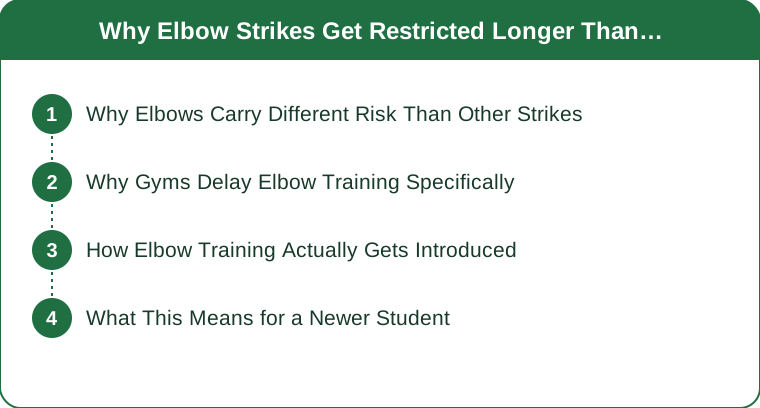
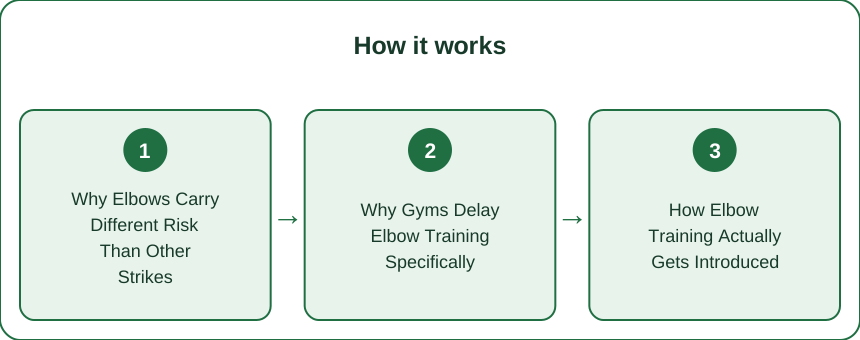
Why Elbows Carry Different Risk Than Other Strikes
The physical reality: the the-concentrated-impact-surface (an elbow strike concentrating force onto a small, hard, bony surface area compared to the more distributed impact of a padded glove or shin, making even moderate-force elbow contact capable of causing cuts and more serious impact injuries), the the-cutting-risk-specifically (elbow strikes carrying a distinctly higher risk of causing cuts requiring stitches compared to other strikes, a safety consideration that applies even in fully controlled sparring), the the-shorter-range-closer-proximity (elbow strikes typically being thrown at very close range, meaning training partners are physically closer together with less reaction time to see and respond to the strike compared to a punch or kick thrown from further away).
Why Gyms Delay Elbow Training Specifically
The pedagogical reasoning: the the-control-precedes-power-principle (a gym generally wanting to see a student demonstrate reliable control and restraint with lower-risk strikes first, as a proxy for how they’re likely to handle a higher-risk technique), the the-partner-trust-requirement (elbow sparring requiring an especially high level of mutual trust and communication between training partners, which typically takes longer to establish for newer students who haven’t trained together as extensively), the the-injury-consequence-severity (the consequence of a poorly controlled elbow strike being disproportionately more severe than a poorly controlled punch or kick, justifying extra caution in how and when it gets introduced).

How Elbow Training Actually Gets Introduced
The progression: the the-pad-work-before-partner-work (elbow strikes typically getting introduced first through pad work with a stationary or actively holding partner, well before live sparring), the the-slow-flow-sparring-first (when elbows are introduced to sparring, it typically happens first in a slow, flowing, cooperative format focused on technique and control rather than full-speed exchange), the the-light-contact-graduated-introduction (full-contact elbow sparring, when it happens at all in a given gym’s culture, generally being introduced gradually and often remains restricted to advanced students or competition-focused training specifically).
What This Means for a Newer Student
The practical takeaway: the the-not-a-sign-of-being-held-back-unfairly (a gym delaying elbow training not reflecting a lack of trust in a specific student’s ability, but a standard, safety-driven progression applied broadly), the the-focus-on-fundamentals-value (the extended time spent on punches, kicks, and knees before elbows still building genuinely transferable skills like distance management and timing that make elbow training safer and more effective once introduced), and the frame (elbow strikes get restricted longer than other Muay Thai techniques because of their concentrated impact and cutting risk at close range — the delay is a standard safety practice, not a judgment on any individual student’s progress.)
The extended delay before elbow strikes enter a Muay Thai student’s training isn’t arbitrary, it reflects the fact that elbows concentrate force onto a small, hard, bony surface at very close range, carrying a distinctly higher risk of cuts and more serious impact injury than the more distributed contact of a padded glove or shin, and the closer proximity involved leaves training partners with less reaction time to see and respond to the strike compared to a punch or kick. Gyms generally want to see reliable control and restraint demonstrated with lower-risk strikes first, treating that as a meaningful proxy for how a student is likely to handle a technique whose poorly controlled version carries disproportionately more severe consequences, and elbow sparring specifically requires a level of mutual trust between partners that takes real time to build. The typical progression reflects this caution directly, introducing elbows first through pad work with a stationary or actively holding partner, then into slow, flowing, cooperative sparring focused on control rather than full-speed exchange, with genuine full-contact elbow sparring often remaining reserved for advanced or competition-focused training specifically. None of this reflects a lack of trust in any individual student, it’s a standard safety-driven progression, and the extended time spent on punches, kicks, and knees beforehand builds transferable skills like distance management and timing that make elbow training safer once it actually arrives.
Keep Reading
This article is for general informational and styling purposes only. Fit, sizing, and product availability may vary.