Muay Thai Conditioning at Home: The Between-Class Training That Accelerates Everything
The Muay Thai student who trains between classes progresses at double speed — not by hitting things, but by conditioning the engine and rehearsing the movements the classes then refine. The home-training guide: the priorities, the sessions and the shadowwork craft.

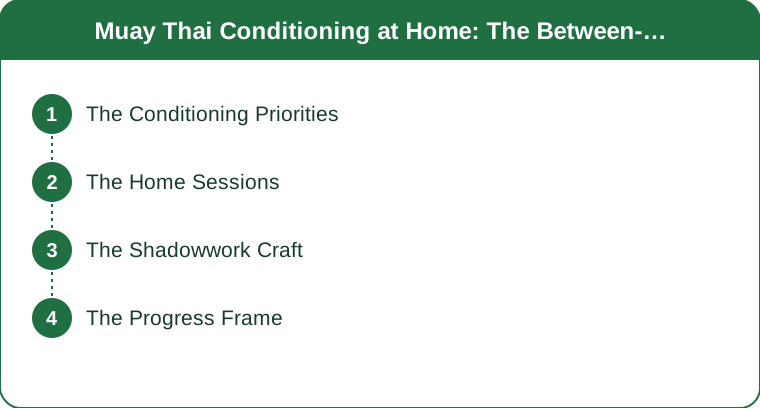
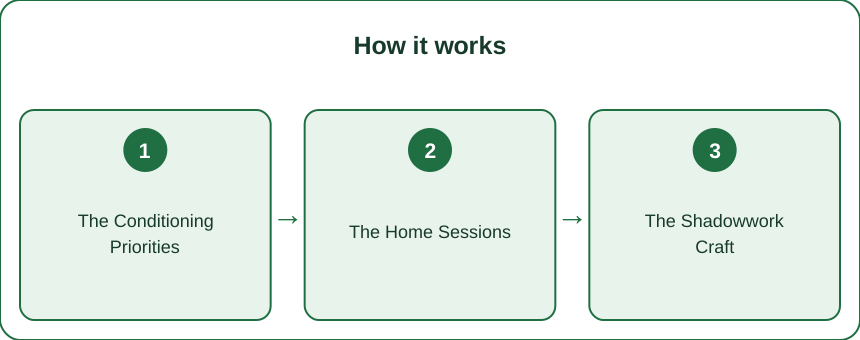
The Conditioning Priorities
What Thai training taxes: the engine demands (the round-based conditioning from the fighting-shape doctrine — the 3-minute work capacity that classes assume; the cardio base that lets you LEARN in round four instead of just surviving), the hip-and-core engine (the roundhouse living in hip rotation — the rotational core work from the core chapters; the kick power being a core product wearing a shin), the leg-endurance specifics (the bounce, the checks, the kicks — the calf-and-quad stamina; the skipping rope as the sport’s own prescription), the flexibility ask (the hip mobility for high kicks and knees — the mobility doctrine’s hip openers with Thai purpose; the patience honesty: the head-kick flexibility being a year project), and the grip-and-posture note (the clinch’s pulling demands — the row-and-carry strength from the pull doctrine as clinch preparation).
The Home Sessions
The no-equipment menu: session A — the rounds circuit (the 3-minute rounds, 1-minute rests: round one skip-or-jog, round two shadowwork, round three bodyweight — squats, push-ups, sit-outs; the three-to-five round formats from the conditioning doctrine), session B — the legs-and-core day (the squat-and-lunge volume, the calf raises, the rotational core circuit — the medicine-ball-less twists and bicycle work; the check-position balance holds), session C — the mobility-and-recovery session (the hip-opener sequence — the deep lunges, cossack squats and butterfly progressions; the post-class stretch routine from the recovery doctrine), the weekly shape (the two-three home sessions BETWEEN class days — the recovery-respecting placement; the classes plus home work totaling five-six training touches), and the equipment upgrades (the skipping rope first — the ten-dollar essential; the resistance band second; the heavy bag as the someday tier per the home-bag doctrine).

The Shadowwork Craft
Rehearsal that builds skill: the shadowwork legitimacy (the fighters’ most-used training tool — the movement rehearsal that builds technique without equipment; the beginner’s version being just as valuable per the shadowboxing doctrine), the structure formula (the round one basics — the stance, steps and jab-cross flow; the round two kicks — the slow roundhouse repetitions with balance focus; the round three combinations — the class’s latest material rehearsed), the quality rules (the full technique at half speed beating sloppy speed — the mirror-or-video check from the form doctrine; the imaginary opponent visualized: the range, the returns, the defense woven in), the class-connection habit (the day’s class material shadowed same-evening — the sleep-consolidation bonus from the skill-learning science; the technique rehearsed within hours sticking double), and the balance emphasis (the kick shadowwork as balance training — the slow-motion roundhouse being a single-leg stability drill; the wobble that shadowwork fixes before pads expose it).
The Progress Frame
Making it compound: the consistency math (the twenty-minute home sessions beating the occasional marathon — the frequency doctrine; the daily-touch ideal even at five minutes), the fatigue honesty (the home work scaled on heavy class weeks — the recovery budget from the masters doctrine; the conditioning that serves classes, never competes with them), the progress markers (the rounds completed without dying, the kicks that balance, the skip-rope streaks — the visible month-over-month arc), the video journal (the monthly shadowwork clip — the technique evolution archived per the progress doctrine; the month-one-versus-month-six comparison being the motivation bank), and the accelerant close (the between-class trainee arriving at each session conditioned and rehearsed — the class time spent on refinement instead of survival; the double-speed progression being real and available; the art learned in the gym, and cemented in the living room). Skip, shadow, stretch the hips: the classes, accelerated from home.
Between classes: round-based conditioning circuits, hip mobility and shadowwork — rehearse the day’s class material the same evening for double retention. A skipping rope is the only equipment that matters early.
Keep Reading
This article is for general informational and styling purposes only. Fit, sizing, and product availability may vary.