7 Reasons Your Punches Slow Down in the Third Round - and How to Fix Each One
Quick Answer: Round-three slowdown is usually four separate problems wearing the same disguise: breathing pattern, unnecessary tension, pacing in rounds one and two, and shoulder-specific endurance. Pure cardiovascular fitness is only one of the seven causes below, and for most people it is not the main one. The fastest fix is almost always breathing - exhaling on every strike and not holding your breath during defense.
Which is why the fittest person in the gym can still fade in round three while a less fit but relaxed fighter does not.
Work through the seven in order; the first three account for most cases.

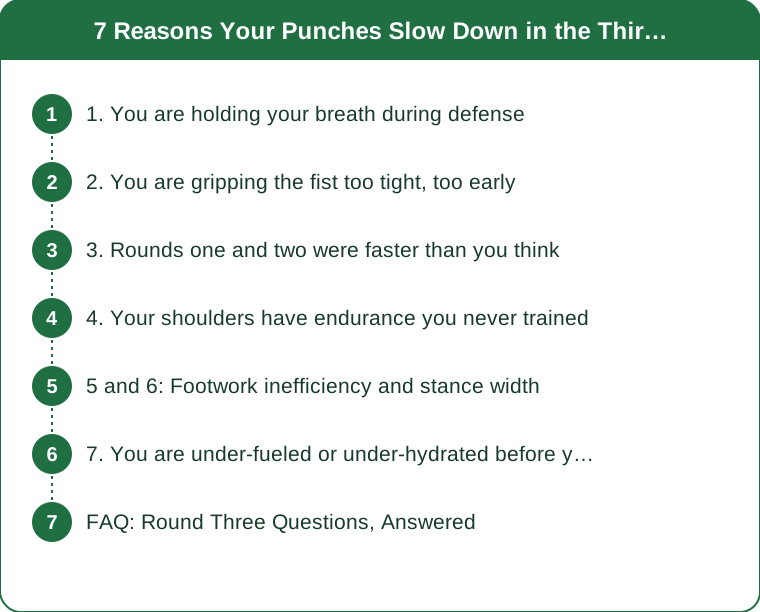
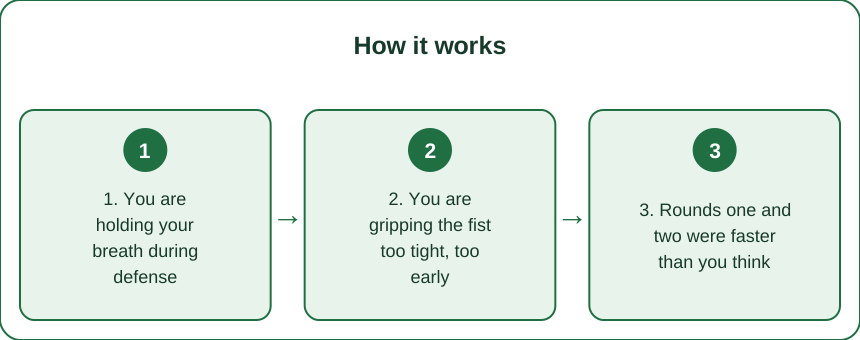
1. You are holding your breath during defense
Everyone learns to exhale on a strike. Almost nobody is taught to keep breathing while defending.
Watch yourself in the next spar: during a flurry, while covering up, while circling out - do you breathe? Most people hold. It is an instinctive bracing response, and it starves you exactly when demand is highest.
A few seconds of breath-holding under load produces an oxygen debt that takes far longer to repay than it took to create. Repeat that ten times a round and round three is decided by round one.
The fix: a continuous rhythm rather than a strike-triggered one. Short sharp exhale on each strike, and a deliberate exhale while covering. Practice on the bag: throw a three-punch combination, then cover for three seconds while exhaling audibly. The audible part is the training tool - if you cannot hear it, you are not doing it.
This is the single highest-return change in the list and it costs nothing.
2. You are gripping the fist too tight, too early
A punch should be a relaxed limb that becomes rigid at the moment of impact and not before. Most tiring fighters are squeezing the fist for the entire round.
Sustained grip tension does two things: it fatigues the forearms fast, and it slows the arm, because a tense muscle cannot accelerate as quickly as a relaxed one. So you get slower and more tired from the same mistake.
The forearm burn people report in round three is very often this, not the shoulders.
The fix: the loose-fist drill. Shadow box a full round with your hands deliberately loose - almost open - closing only at the instant of contact with an imaginary target. It will feel wrong and your speed will noticeably increase.
Also check your wraps and gloves. Wraps that are too tight force a permanently semi-clenched hand and contribute directly to forearm fatigue.
3. Rounds one and two were faster than you think
The slowdown often has nothing to do with round three. It was set up by an unsustainable first two rounds.
Adrenaline masks effort early. You feel fresh, so you throw at 90% output, which is a pace nobody sustains for five rounds. The fatigue arrives on schedule and it feels like it came from nowhere.
The test: have someone count your strikes per round, or count them on video. If round one has 40% more strikes than round three, pacing is your problem, not conditioning. A relatively even count across rounds means you paced correctly and the cause is elsewhere on this list.
The fix: deliberately throttle round one to roughly 70% output. It feels lazy. Then compare your round three to what it used to be. Most people find the total work done goes up, not down.
Also: defend more in round one. Reading and moving costs far less than throwing, and it buys information you use later.

4. Your shoulders have endurance you never trained
Holding a guard is an isometric shoulder contraction, sustained for three minutes at a time. Almost nobody trains for that specifically, and general cardio does not build it.
The symptom is distinctive: the guard drops before the legs get tired. Your breathing is fine, your feet still move, and your hands are somewhere around your ribs.
The fix - two drills, twice a week:
- Guard holds. Hold a proper guard for three minutes, standing still, no punching. It is much harder than it sounds. Build to three rounds.
- Light dumbbell shadow boxing. 2-3 lb dumbbells (not heavier - heavier changes your mechanics) for one round, then one round without. The contrast round after is where the adaptation is felt.
What not to do: heavy overhead pressing on the assumption that stronger shoulders equals better guard endurance. Isometric endurance is fairly specific, and heavy pressing the day before sparring makes round three worse, not better.
5 and 6: Footwork inefficiency and stance width
5. You are moving more than you need to
Excess movement is expensive. Bouncing continuously, resetting stance after every strike, or drifting backward in straight lines all cost energy that buys nothing.
The tell: you are more tired than your opponent and you landed fewer strikes.
The fix: film a round and watch only your feet. Count how many steps happen without a purpose - not setting up a strike, not evading, not creating an angle. Most people are shocked. Aim for economy: small steps, weight already where it needs to be, and stillness when nothing is happening. Stillness is a skill.
6. Your stance is too wide or too narrow
Too wide makes every movement a full weight transfer and locks up your hips - common in people who were taught a boxing stance and then added kicks.
Too narrow costs balance, so you spend energy on constant micro-corrections you never notice.
The check: you should be able to throw a rear kick without a preparatory step, and check a kick without shifting weight first. If either requires a setup step, adjust width and retest. Roughly shoulder-width with the rear heel light is the starting point for most people.
7. You are under-fueled or under-hydrated before you start
The least technical item and the one that quietly ruins the most sessions.
Dehydration of even a small percentage of body weight measurably impairs endurance performance and perceived effort. A training session that starts at a fluid deficit is a session where round three was always going to be hard.
Glycogen matters at this intensity. Muay Thai training is glycolytic - it runs primarily on carbohydrate. Training in the evening after a low-carbohydrate day means the tank is partly empty before the first bell.
The fix:
- Drink through the day, not right before. Chugging water twenty minutes out does not hydrate you; it just sits there.
- Eat a carbohydrate-containing meal 2-3 hours before training. Rice, oats, fruit, bread - unglamorous and effective.
- A small snack 30-60 minutes out if the last meal was more than four hours ago.
- In late-summer heat, add electrolytes - a heavy sweat session loses meaningful sodium, and plain water alone can leave you feeling worse.
If you fade in round three regardless of what you do, and especially if you feel dizzy or unusually breathless, that is worth a conversation with a doctor rather than more conditioning work. This is general information, not medical advice.
FAQ: Round Three Questions, Answered
Should I just do more roadwork?
Add it if your general conditioning is genuinely low, but most gym-fit fighters fade for the reasons above, not for lack of aerobic base. Fix breathing, tension, and pacing first - those take two weeks and cost nothing.
How long until these fixes show up?
Breathing and relaxation changes show within 2-3 sessions. Shoulder endurance takes about 3-4 weeks. Pacing is immediate once you decide to do it.
Is it normal for the third round to be the worst?
Rounds three and four are the classic wall for most people - it is roughly where the anaerobic buffer runs out and pacing errors come due. Normal, and highly trainable.
TL;DR:
- Breathe during defense, not just on strikes. Audible exhales while covering - the single biggest fix.
- Loose fist until impact. Sustained grip tension makes you slower and more tired at the same time.
- Count your strikes per round. A 40% drop from round one means pacing, not conditioning.
- Train guard endurance specifically with three-minute holds and light dumbbell shadow boxing.
- Fuel and hydrate through the day, and check stance width - both cost energy invisibly.
Work the first three for two weeks before adding any conditioning. Most people find round three arrives feeling like round two did. This is general information, not medical advice.
Keep Reading
This article is for general informational and styling purposes only. Fit, sizing, and product availability may vary.