7 Reasons Your Guard Drops Without You Noticing
Quick Answer: Your guard drops because holding your hands up is expensive and your body optimises for cost. The seven causes are shoulder endurance failure, breathing pattern, dropping to see, dropping after your own strikes, dropping when tired late in a round, dropping under pressure as a flinch response, and dropping because your guard position was never mechanically sustainable in the first place. Fixing the last one first solves several of the others, because a structurally efficient guard is much cheaper to hold.
You watch the video back and your hands are at chest height for most of round two. You have no memory of lowering them.
That is the point: a dropping guard is almost never a decision. It is the result of a system running out of something. Here is what runs out, in the order it usually happens.

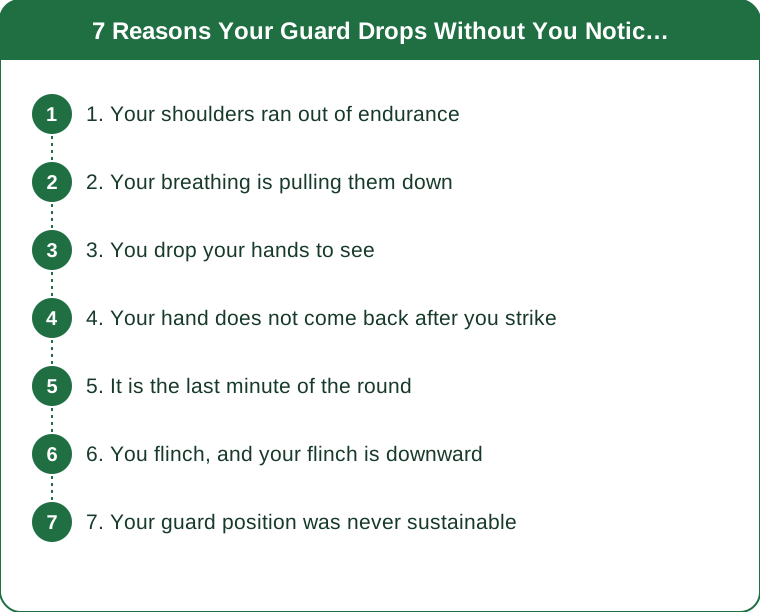
1. Your shoulders ran out of endurance
The most common cause and the most trainable.
What is happening. Holding your hands at head height requires sustained isometric contraction of the anterior and medial deltoid, plus the upper trapezius. Isometric holds fatigue quickly, and the deltoid is a comparatively small muscle being asked to work continuously for a three-minute round.
Why it appears suddenly rather than gradually. Isometric endurance has a fairly sharp failure point. You hold the position fine, then within about thirty seconds you cannot, and your hands drift down before you register the change.
The training fix, which is specific:
- Timed guard holds. Hold your guard position, no movement, for 3 minutes. Rest 1 minute. Repeat 3 times. Add 30 seconds weekly. Unglamorous and effective.
- Shadow boxing with light weights, 0.5 to 1kg, for 2 minutes, then immediately without. The unweighted round feels easy and the position becomes familiar.
- Overhead carries and holds, which build the same isometric capacity with more load tolerance.
What does not fix it: being told to keep your hands up. If the muscle cannot sustain the position, attention will not change the outcome, it will only make you aware of it happening.
2. Your breathing is pulling them down
An underrated mechanical link that shows up in almost everyone.
The connection. The upper trapezius and the scalene muscles assist breathing when you are working hard. They also help hold your shoulders up. When those muscles are recruited for breathing, they cannot do both jobs, and the guard is what gets sacrificed.
Why chest breathing makes it worse. Shallow upper-chest breathing recruits accessory breathing muscles heavily. Diaphragmatic breathing does not, leaving the shoulder girdle free to hold position.
The observable sign: if your shoulders visibly rise and fall with each breath by round two, you are chest breathing, and your guard will follow the pattern down.
The fix:
- Practise nasal breathing during light rounds, which forces a slower, deeper pattern.
- Exhale sharply on strikes, which is standard coaching and also resets the breathing pattern rather than letting it become shallow and continuous.
- Between rounds, breathe out longer than you breathe in. A 4-second out, 4-second in pattern for the full minute recovers more than gulping air does.
Why this compounds with cause 1. Fatigued shoulders and accessory breathing are competing for the same muscles. Improving conditioning improves breathing and vice versa, which is why fighters who fix one often find the other resolves partly on its own.
3. You drop your hands to see
A vision problem being solved with a defensive compromise.
What happens. A tight, high guard reduces your field of view. Under pressure, particularly against an unfamiliar opponent or a faster one, the instinct is to widen the gap to see the incoming strike.
Why it feels correct in the moment. You do see more. You also open the line you just widened, which is why the shot that lands is usually straight through the middle.
The actual fix is not to look harder, it is to look somewhere else. Focusing on the upper chest or the base of the neck rather than the hands or the face uses peripheral vision to track both hands simultaneously. You do not need to see a punch clearly to react to it, you need to detect motion, which peripheral vision does better than central vision.
The drill: have a partner throw slow strikes while you deliberately fix your gaze on their sternum. It feels wrong for two sessions and then it works.
A related fix: adjust the guard rather than dropping it. Hands slightly wider apart, at the same height, preserves protection while opening the sightline. This is what experienced fighters do instead of lowering.

4. Your hand does not come back after you strike
The most punished version, because it happens exactly when you are exposed.
What is happening. The retraction of a punch is a separate motor action from the extension, and it is the one that gets neglected in training. Pad work rewards the strike landing, not the hand returning, so the return gets sloppy.
The specific patterns:
- The jab hand drops on the way back, taking a low path instead of returning along the line it went out.
- The rear hand stays out admiring the cross while the opponent’s counter comes over the top.
- The lead hand drops during a kick, because the arm swings for balance and momentum.
The kick version is worth separating out. In Muay Thai the arm swing on a roundhouse generates rotation, so some drop is mechanically useful. The error is dropping the opposite hand, the one that should be protecting the head on the side the counter comes from.
The fix:
- Train the return, not the strike. Have your pad holder call out when a hand does not return, and treat that as the failed rep regardless of how the strike landed.
- Throw at 70 percent for whole rounds, focusing entirely on the return path. Speed reintroduces the error, so build the pattern slow.
- Snap the strike back rather than pulling it. A snapped strike returns along its own line automatically.
5. It is the last minute of the round
Fatigue-driven guard drop is a different problem from endurance-driven guard drop.
The distinction. Cause 1 is local shoulder endurance. This is systemic fatigue, where everything degrades, and the guard is simply the most visible casualty.
What degrades, in order: technique precision, footwork, then guard, then decision-making. If your guard is dropping in the last minute along with your feet going flat, the issue is conditioning rather than shoulders.
The conditioning that transfers. Sport-specific conditioning matters here more than general fitness. Rounds of pad work, bag work at fight pace, and clinch work build the specific capacity. Long slow running builds a base and does not by itself hold your guard up in round three.
A structural check: if your guard is fine in rounds one and two and gone in round three, you are pacing wrong rather than conditioned wrong. Fighters commonly spend round one at an intensity they cannot sustain and pay for it later.
The pacing fix: deliberately work at 80 percent in round one for several sessions. Most people find round three improves more than any conditioning block delivers.
6. You flinch, and your flinch is downward
A reflex problem, and reflexes are trainable with the right exposure.
What the natural flinch response does. The startle reflex pulls the head down and forward, raises the shoulders, and turns the face away. Parts of that are useful, since tucking the chin is correct. Turning away and closing the eyes is not, and the hands frequently move to a protective position that is lower and wider than a proper guard.
Why it survives training. The startle reflex is subcortical and fast, so it fires before any trained response. You cannot think your way out of it. You can, however, replace it with a different trained reflex through repeated low-threat exposure.
The exposure that works:
- Light, high-volume partner drills where strikes come toward the face at low power and high frequency. The goal is habituation, not defence.
- Eyes-open drilling specifically. Have a partner touch your gloves and forehead lightly while you maintain gaze. Blinking is fine, turning away is the thing to eliminate.
- Gradual intensity increase. Going too hard too soon reinforces the flinch instead of extinguishing it.
An important note: a persistent flinch after a hard sparring session or a knockdown is normal and it usually needs lower-intensity work for a period rather than pushing through. Pushing through reinforces it.
7. Your guard position was never sustainable
The cause that fixes several of the others, and the one nobody checks.
What an inefficient guard looks like. Hands held forward of the head rather than close to it, elbows flared out, shoulders shrugged up toward the ears. Each of these increases the moment arm at the shoulder, which increases the muscular effort required to hold the position for every second of every round.
What an efficient guard looks like:
- Hands close to the head, roughly at cheekbone height, touching or nearly touching
- Elbows down and in, protecting the body and letting the arm’s weight be supported partly by structure rather than entirely by muscle
- Shoulders down, not shrugged. A shrugged shoulder fatigues the upper trapezius quickly and offers no extra protection
- Chin tucked, which reduces how high the hands need to be
The arithmetic. Holding your hands 15cm further forward can substantially increase the torque your shoulder must resist. Over a three-round fight that is a large amount of extra work for no defensive benefit.
Why this fixes other causes. A structurally efficient guard is cheaper to hold, so shoulder endurance lasts longer, so late-round drop is reduced, and so the accessory breathing muscles are less contested.
FAQ: Guard Questions, Answered
Why do my hands drop even when I am concentrating on keeping them up?
Because it is usually a capacity problem, not an attention problem. Isometric shoulder endurance fails fairly sharply, and no amount of focus keeps a fatigued muscle contracting. Train timed guard holds.
Is it normal for the guard to drop when kicking?
Some arm movement on a roundhouse is mechanically useful for rotation. The error is dropping the opposite hand, which is the one protecting the side a counter comes from.
How long does it take to fix a dropping guard?
Structural changes to guard position show up within a few sessions. Shoulder endurance takes four to six weeks of specific work. Flinch responses take longer and need consistent low-intensity exposure.
Seasonal note: gyms get busier from September onward as people return from summer, which usually means more sparring partners and more rounds. That is good for exposure work and it also means more fatigue accumulating across the week, so the late-round drop tends to get worse in autumn before it gets better.
TL;DR:
- A dropping guard is a capacity problem, not an attention problem, so being told to keep your hands up does not fix it.
- Fix the guard’s structure first. Hands close to the head, elbows in, shoulders down. It makes everything else cheaper.
- Train timed isometric guard holds. Three minutes on, one off, three rounds, adding time weekly.
- Diaphragmatic breathing frees the shoulder muscles that would otherwise be recruited for breathing.
Film one round this week and watch only your hands. Almost everyone is surprised by where they actually are.
Keep Reading
This article is for general informational and styling purposes only. Fit, sizing, and product availability may vary.