7 Reasons Your Elbows Feel Awkward in Combinations
Quick Answer: Elbows feel awkward in combinations because they need a completely different range than punches, and most people try to throw them from punching distance. The other common causes are chambering too early, rotating the shoulders instead of stepping in, dropping the opposite hand, and treating the elbow as a finisher rather than a range-appropriate tool. Fix the distance first — the other six issues shrink considerably once the range is right.
Elbows are the strike that separates Muay Thai from most striking arts, and they are the one that most frustrates intermediate students. Here are the seven specific reasons the transition breaks down, and what each one actually needs.

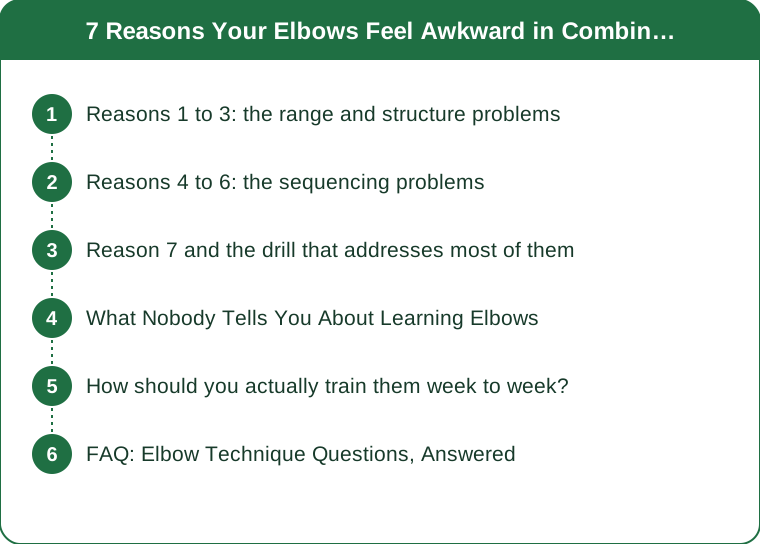
Reasons 1 to 3: the range and structure problems
1. You are throwing from punching range
This is the dominant cause and it accounts for more awkward elbows than the other six combined. A cross lands at roughly arm’s length. An elbow needs you six to twelve inches closer than that, and no amount of reaching fixes the gap — reaching only turns a structurally sound strike into a slap with the forearm.
The fix is a step, not a lean. Your lead foot should advance as the elbow travels, closing distance with your whole body. Drill this in isolation: jab, step, elbow. Feel where the step has to land before the elbow can work.
2. You chamber too early and telegraph it
Pulling the elbow back before throwing it is instinctive and it announces the strike two beats in advance. The elbow should travel from wherever your guard already is, on the shortest available path.
Drill it with your hand touching your temple. From that position there is no chamber available, which forces the short path. It feels weak at first and it is significantly faster.
3. Your shoulders rotate but your feet do not
Rotation without a corresponding step generates torque and no distance change. You end up spinning past your target rather than through it. The hips and feet lead, the shoulder follows — and if your rear foot is not pivoting, the elbow is being thrown entirely with your arm.
Reasons 4 to 6: the sequencing problems
4. You treat the elbow as a finisher
Elbows are frequently drilled as the end of a combination, which trains you to throw them only when you have already committed. In practice elbows work best as entries and interruptions — thrown as you close, or thrown to break an opponent’s rhythm mid-exchange.
Drill combinations that start with the elbow: elbow, cross, hook. It reorganizes your sense of when the strike is available.
5. The opposite hand drops
Watch any footage of yourself throwing elbows and the non-striking hand is almost certainly lower than it should be. Elbow range is exactly the range where you are most vulnerable to a counter elbow, and a dropped guard there is expensive.
The cause is usually the same as the chambering problem: recruiting the whole upper body for power that the strike does not need. A properly ranged elbow needs very little power input because the weapon is bone and the distance is short.
6. You are throwing the wrong elbow for the angle
Horizontal, diagonal, upward, and spinning elbows each have a specific range and entry angle. Trying to force a horizontal elbow when the opening is on a downward diagonal produces the awkwardness you are feeling — the strike is fine, the selection is wrong.
Drill the four basic elbows against the same pad position and notice which one arrives cleanly. That is the one the angle was asking for.
Reason 7 and the drill that addresses most of them
7. Your combinations are practiced at one speed
Most gym combinations are drilled at a consistent tempo, which is fine for conditioning and terrible for elbow timing. Elbows work on a broken rhythm — the strike lands in the gap where an opponent expects the next punch.
Drill the same combination at three tempos: even, delayed on the elbow, and rushed on the elbow. The delayed version is the one that works in sparring, and it feels wrong the first fifty times.
The drill that addresses reasons 1, 3, 5, and 7 at once:
With a partner holding a single pad at head height, start at punching range. Throw a jab that falls deliberately short. As it returns, step forward and throw a horizontal elbow. Reset. Twenty repetitions each side.
The short jab does three things: it establishes the range gap, it gives your body a reason to step, and it keeps the non-striking hand engaged. The step is the entire lesson, and once your feet learn it, the elbow stops feeling like a separate skill bolted onto your combinations.

What Nobody Tells You About Learning Elbows
They feel wrong for longer than other strikes, and that is normal.
A roundhouse kick feels awkward for a few weeks. Elbows commonly feel awkward for months, because the required range contradicts everything your punching has trained. You are not slow at learning them; you are unlearning a distance habit.
Second: pad work flatters elbows badly. A pad holder presents a stationary target at a convenient height and often steps into the strike. Sparring provides neither. If your elbows feel excellent on pads and terrible in sparring, that gap is expected and it is about range, not technique.
Third: elbows are the strike where control matters most in training. Even light contact to the head with a point of bone causes cuts, and most gyms restrict elbows in sparring for exactly that reason. Wear elbow pads for any contact drilling and check your gym’s rules before throwing them in a round.
And fourth, elbow conditioning is not a thing in the way shin conditioning is. There is no beneficial adaptation from striking hard objects with your elbow — you are just risking bursitis. Skip anything that suggests otherwise.
This is general information, not medical advice.
How should you actually train them week to week?
Small consistent exposure beats occasional heavy focus.
Twice a week, ten minutes. Not a full session. Elbows are a precision skill and precision degrades with fatigue, so ten focused minutes at the start of a session outperforms thirty at the end.
Shadow work daily, thirty seconds. Entries only — step and elbow, no combination. This is the movement your body needs to make automatic, and it costs nothing.
One combination per month. Pick a single elbow combination and drill it until it is available without thought. Rotating through six combinations means owning none of them.
Film once a month. The dropped hand and the missing step are both invisible from the inside and obvious on video. Thirty seconds of footage tells you more than an hour of feeling for it.
As gyms fill up again in September after the summer lull, partner drilling gets easier to arrange — a good moment to move elbow work from bag and pads to partner range, which is where the distance lesson actually lands.
FAQ: Elbow Technique Questions, Answered
Should beginners learn elbows at all?
Yes, but as a range and structure skill rather than a weapon early on. Learning the entry and the guard discipline from the start prevents the punching-range habit from setting in, which is much harder to undo later.
Which elbow is most useful in sparring?
The horizontal and the diagonal downward, in most gyms. Spinning elbows are spectacular and low percentage, and upward elbows require a specific clinch or entry position that comes up less often at intermediate level.
Why do my elbows hurt after heavy bag work?
Usually striking with the point of the elbow rather than the forearm just above it, or bag work at the wrong distance forcing a jammed impact. Reduce power, check that the contact surface is the flat area near the tip, and stop if there is any joint swelling.
This is general information, not medical advice.
TL;DR:
- Distance is the root cause — elbows need six to twelve inches closer than a punch, and a step rather than a reach.
- Do not chamber; throw from where your guard already is, on the shortest path.
- Practice elbows as entries and interruptions, not as combination finishers.
- The short-jab-then-step-elbow drill addresses four of the seven problems at once.
Work the entry for ten minutes at your next session and film thirty seconds of it. The step is almost always missing, and it is almost always the whole answer.
This is general information, not medical advice.
Keep Reading
This article is for general informational and styling purposes only. Fit, sizing, and product availability may vary.