7 Reasons Your Combinations Fall Apart the Moment You Add Speed
Quick Answer: Combinations break at speed because the recovery between strikes is the part you have not trained. Slow practice rehearses the strikes; speed exposes the transitions. The usual culprits are incomplete weight transfer, a hand that does not return, foot position that does not reset, breathing that stops, over-rotation on the first strike, telegraphing the second, and simply sequencing more strikes than your balance can carry.
Three-strike combination on the bag at half pace. Textbook.
Coach calls the same thing on pads at full speed and by strike two you are leaning, by strike three you are off balance and reaching.
Here are the seven places it actually breaks, in the order they usually happen.

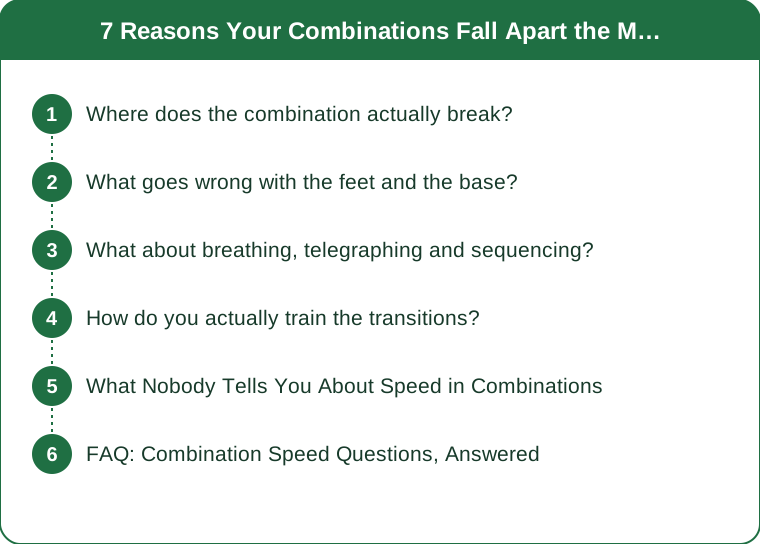
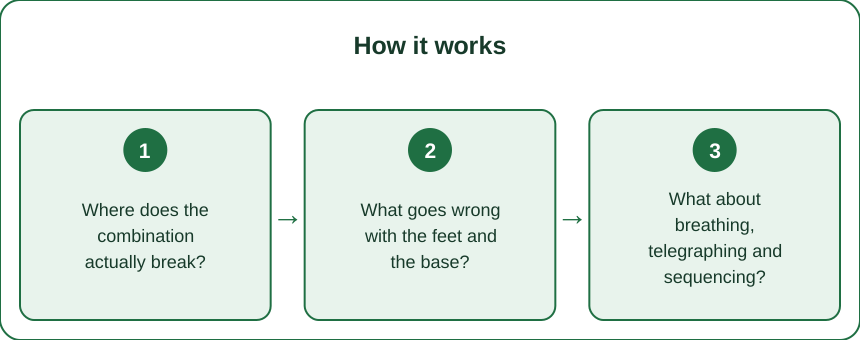
Where does the combination actually break?
1. Your weight transfer is incomplete between strikes
At slow speed you have time to fully shift, settle and reload. At speed, strike two leaves before your weight has finished arriving from strike one, so you throw off a base that is still moving.
The tell is leaning rather than rotating. If your head travels outside your lead foot on strike two, the transfer never completed.
Fix it by drilling two-strike combinations only, at full speed, with a deliberate pause after. Ten reps, checking your base each time. The pause teaches your body where the weight is supposed to end up, which is exactly the information speed erases.
2. The hand does not come back
A punch is two movements — out and back — and speed drills only ever reward the first. Under fatigue and speed the return shortens, then disappears, and the guard is down before the next strike lands.
This is where most counters land, and it is the single most common thing coaches shout about.
Drill the return specifically: throw at full speed, and have a partner tap the open side immediately after. Slow the combination until the return is complete, then rebuild speed. Speed built on a broken return is speed you will have to unlearn.
What goes wrong with the feet and the base?
3. Your feet never reset
Each strike moves your stance slightly. Three strikes without a reset and you are in a stance you would never choose — too square, too wide, or with your weight on the wrong leg.
Watch your own footage and look only at the feet. Most people are surprised by how far they have travelled by strike three.
Drill it by calling the combination and then immediately checking your stance without adjusting. Whatever you are standing in is what you actually did.
4. You over-rotate the first strike
A hard opening cross or roundhouse thrown at maximum commitment leaves you rotated past your base. Everything after that is a recovery, not a strike.
The first strike in a combination should be roughly 70 to 80 percent — enough to be real, not enough to compromise what follows. The final strike is where full commitment belongs.
This single change fixes more combination problems than any amount of extra conditioning, and most people resist it because throwing the first one hard feels stronger.
What about breathing, telegraphing and sequencing?
5. You stop breathing
Breath-holding through a combination is nearly universal at speed. It stiffens the shoulders, slows the return and puts you in oxygen debt within two rounds.
Each strike gets its own sharp exhale. Not one exhale for the combination — one per strike. It sounds fussy and it changes both speed and endurance noticeably within a couple of weeks.
Drill it by making the exhale audible. If you cannot hear strike three, you did not breathe on it.
6. The second strike telegraphs
At speed, people load the second strike during the first — dropping the hand, dipping the shoulder, or shifting weight early. Against a bag it costs nothing. Against a person it is the whole fight.
Film yourself from the front at full speed. Anything that moves before it needs to is a tell.
7. You are throwing more strikes than your balance can carry
Most people’s honest limit at full speed is two or three strikes with complete recovery. Four and five strike combinations look impressive and are usually being carried by compromised balance.
Build from two. When two are genuinely clean at speed — full transfer, full return, feet reset — add the third. This is slower to build and considerably faster to arrive.

How do you actually train the transitions?
The transitions need their own training time, separate from the strikes.
Drill two-strike units at full speed with pauses. The pause is the point. It gives you feedback on where you finished, which continuous drilling never does.
Use a mirror for feet and hands, and film for everything else. You cannot watch your own return in a mirror while throwing at speed. Video at 60 frames per second, watched at quarter speed, shows every one of these seven problems in about thirty seconds.
Shadow box at full speed with no target. Without impact, nothing rewards over-committing, and the balance problems become obvious immediately.
Ladder your speed: 60, 80, 100 percent. Three rounds of the same combination at rising speed shows you exactly which percentage it starts breaking at. That percentage is your real working speed.
Ask your pad holder to hold for recovery, not just for strikes. A good holder will present the pad for strike two slightly late, forcing you to hold position rather than rushing.
Train tired deliberately, but only combinations you already own. Adding speed to a broken pattern under fatigue reinforces the break.
Seasonal note: gyms get busier from September onward, which usually means shorter pad rounds and more bag work. Bag work is where returns and resets quietly degrade because nothing punishes them — so this is the season to be more deliberate about filming yourself.
What Nobody Tells You About Speed in Combinations
Speed is not the goal — recovery time is. Two strikes with full recovery beats four strikes that leave you off balance every time, in every context.
Your slow technique is not your real technique. What you do at 100 percent under pressure is your technique. Everything else is a rehearsal of it.
Fatigue exposes the same seven things in the same order. If you know which one goes first for you, you know what to drill.
Power comes from the transfer, not the arm. People trying to add speed usually tense the arms, which slows the strike and shortens the return simultaneously.
Pad holders shape your habits enormously. A holder who chases your strikes teaches you to reach. A holder who holds position teaches you distance.
Two-strike combinations win fights. The long combinations look good in highlight footage. Watch what actually lands and it is usually two.
Film once a month, not once a year. It is uncomfortable and it is the fastest feedback available. Most of these problems are invisible from the inside and obvious on video.
FAQ: Combination Speed Questions, Answered
Should I just practise slower until it is perfect?
Slow practice builds the strikes but not the transitions. Practise two-strike units at full speed with pauses instead — that trains the part that is actually breaking.
How many strikes should a combination be?
Two or three for most people, executed with full recovery. Add a fourth only when three are genuinely clean at full speed.
Why do my kicks break down before my punches?
Kicks require a larger weight transfer and a longer recovery, so they expose incomplete transfer sooner. The mechanism is identical.
Is this a conditioning problem?
Rarely. Conditioning determines how long you can hold good mechanics, not whether you have them. If it breaks in round one, it is technique.
How often should I film myself?
Once a month is enough to catch drift. Front-on at full speed, watched in slow motion.
What is the single highest-value fix?
Throw the first strike at 70 to 80 percent and save full commitment for the last one. It fixes balance, telegraphing and recovery simultaneously.
TL;DR:
- Combinations break in the transitions, not the strikes — that is the part slow practice never trains.
- The seven: incomplete transfer, no hand return, feet never reset, over-rotated first strike, held breath, telegraphed second strike, too many strikes.
- Drill two-strike units at full speed with a pause and check your base each rep.
- Throw the first strike at 70 to 80 percent; commit fully only on the last.
- One sharp exhale per strike, and film yourself front-on once a month.
Recovery time is the metric. Speed is what you get once recovery is clean.
Keep Reading
This article is for general informational and styling purposes only. Fit, sizing, and product availability may vary.