7 Reasons Your Muay Thai Roundhouse Kick Keeps Losing Power
Quick Answer: Lost roundhouse power almost always traces back to hip rotation, not leg strength — check your pivot foot and hip turn before assuming you need more conditioning.
Your kick used to snap the pad back. Lately it just kind of… lands. Nothing hurts, nothing’s obviously wrong, but the power is quietly gone. Here are the seven most common reasons, roughly in order of how often coaches actually see them.

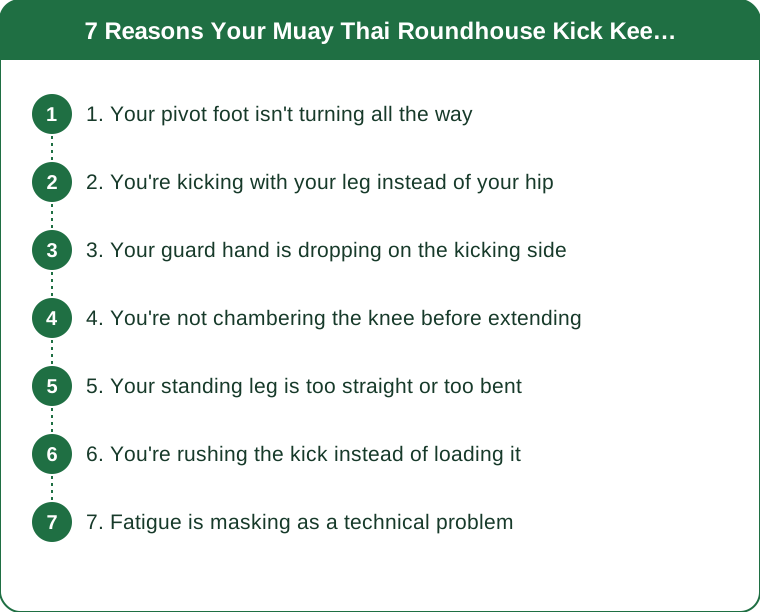
1. Your pivot foot isn’t turning all the way
Power comes from hip rotation, and hip rotation is capped by how far your standing (pivot) foot turns. If your heel isn’t pointing roughly at the target by the time your kick lands, your hips physically can’t rotate all the way through — you’re kicking with your leg alone.
2. You’re kicking with your leg instead of your hip
A common plateau: the leg swings but the hip trails behind it instead of leading. The fix is to think of the hip as throwing the leg, not the leg dragging the hip along — drilling slow-motion kicks against a wall bag helps isolate this.
3. Your guard hand is dropping on the kicking side
When the same-side hand drops as the kick fires, it’s usually a sign the shoulder isn’t rotating with the hip — and shoulder rotation adds real torque to a roundhouse. Keep both hands up through the kick and you’ll often feel the power return immediately.

4. You’re not chambering the knee before extending
Skipping the knee-chamber (bringing the knee up and across before the shin extends) turns the kick into a slower, looping motion instead of a snap. The chamber is what lets the shin whip through at the end instead of arriving slow.
5. Your standing leg is too straight or too bent
A locked-straight standing leg limits hip rotation the same way a flat pivot foot does; an overly bent standing leg drains power into absorbing your own bodyweight instead of transferring it into the kick. A slight, athletic bend is the target.
6. You’re rushing the kick instead of loading it
Power kicks need a brief load phase — weight shifting onto the standing leg before the kicking leg fires. Kicks thrown from a flat-footed, unloaded stance land soft no matter how fast the leg moves.
7. Fatigue is masking as a technical problem
Late in a hard round, hip rotation is the first thing to shrink as the legs tire — so a kick that felt strong in round one and weak in round three might not be a technique issue at all, just conditioning catching up. Track whether the drop-off is consistent from round one, or only shows up late.
TL;DR:
- Most lost roundhouse power comes from an incomplete pivot, not weak legs
- Chamber the knee, rotate the hip, keep the guard hand up through the kick
- A slight bend in the standing leg beats locked-straight or over-bent
- Late-round power loss is often fatigue, not technique — track when it happens
Next pad session, have a training partner watch just your pivot foot for one round — for most people, that single fix brings back more power than a month of extra conditioning.
Keep Reading
This article is for general informational and styling purposes only. Fit, sizing, and product availability may vary.