7 Reasons Your Kicks Feel Weaker Than They Did Last Month
Quick Answer: A kick that feels weaker than it used to is usually a technique regression — incomplete hip rotation, a rushed setup, or fatigue compensation — rather than a strength loss, and it’s almost always fixable within a few focused sessions.
It’s a common plateau moment: the kick used to land with a satisfying thud and now it feels flat, even though nothing about your training volume changed. Here’s what’s usually actually going on.

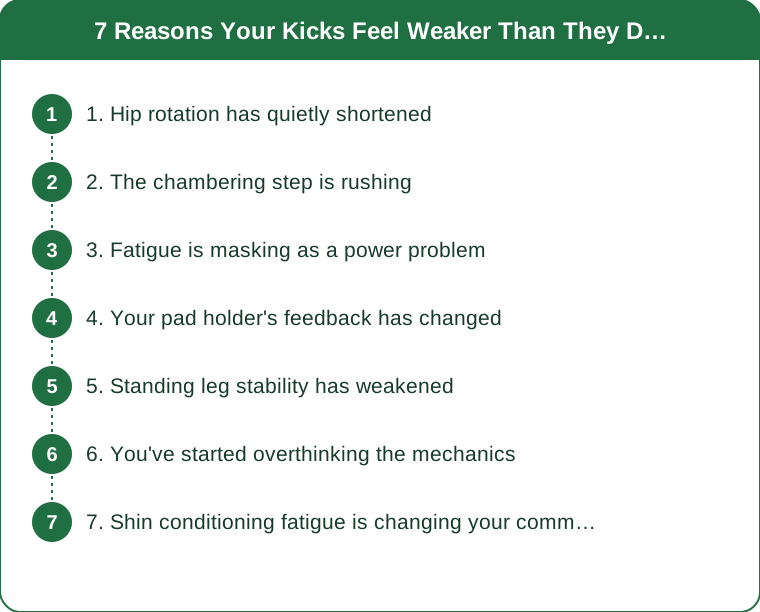
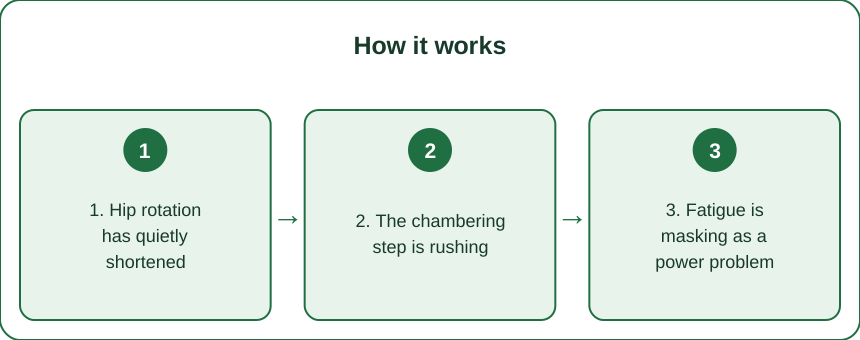
1. Hip rotation has quietly shortened
As kicks become more automatic, it’s common to unconsciously cut the hip turn short, relying more on leg swing for power. Full hip rotation is where most kick power actually comes from, so a shortened turn shows up immediately as reduced impact even with identical leg speed.
2. The chambering step is rushing
A fast, complete chamber — knee up and rotated before the leg extends — sets up the whole kick. If chambering has gotten sloppy from speed drilling, the kick loses its base even if it looks fast.
3. Fatigue is masking as a power problem
Cumulative training fatigue reduces explosive output well before it affects perceived effort, so a kick can feel just as hard to throw while landing noticeably softer. Tracking whether the weak-kick feeling clusters on high-volume weeks points straight at this.

4. Your pad holder’s feedback has changed
If you’re used to a specific partner’s pad angle and they’ve been away, a new holder’s slightly different pad position can make a technically fine kick feel like it’s not landing right, even when it is.
5. Standing leg stability has weakened
A wobbly base leg bleeds power out of the kick before it reaches the target, since force generation depends on a stable platform to push off from. This is often the quiet culprit behind a kick that feels ‘floaty.‘
6. You’ve started overthinking the mechanics
Conscious micromanaging of a previously automatic movement — checking hip angle, foot position, chamber height mid-kick — introduces hesitation that a well-drilled kick doesn’t have room for. Trusting the trained pattern usually restores power faster than more correction does.
7. Shin conditioning fatigue is changing your commitment
Sore or tender shins from recent conditioning work can cause a subconscious pull-back right at impact, even if you’re not aware of holding anything back. Letting shins recover for a few sessions often brings the power straight back.
TL;DR:
- A weaker kick is usually technique or fatigue, not lost strength
- Full hip rotation and a complete chamber are the biggest power sources
- Cumulative fatigue and shin soreness can quietly reduce commitment to impact
- Trust the drilled pattern instead of overthinking mechanics mid-kick
Most of these resolve within one to two focused weeks once you know which one is actually at play.
Keep Reading
This article is for general informational and styling purposes only. Fit, sizing, and product availability may vary.