7 Pad-Holding Mistakes That Are Quietly Slowing Down Your Muay Thai Partner
Quick Answer: Common pad-holding mistakes — flinching before impact, holding pads at the wrong angle, and not giving real feedback on power and timing — quietly cap a training partner’s technical progress even when their actual striking practice reps look high in volume.
Strikers get all the technique feedback in most gyms, but the person holding pads is shaping that technique just as much, for better or worse, with habits that often go completely unexamined.

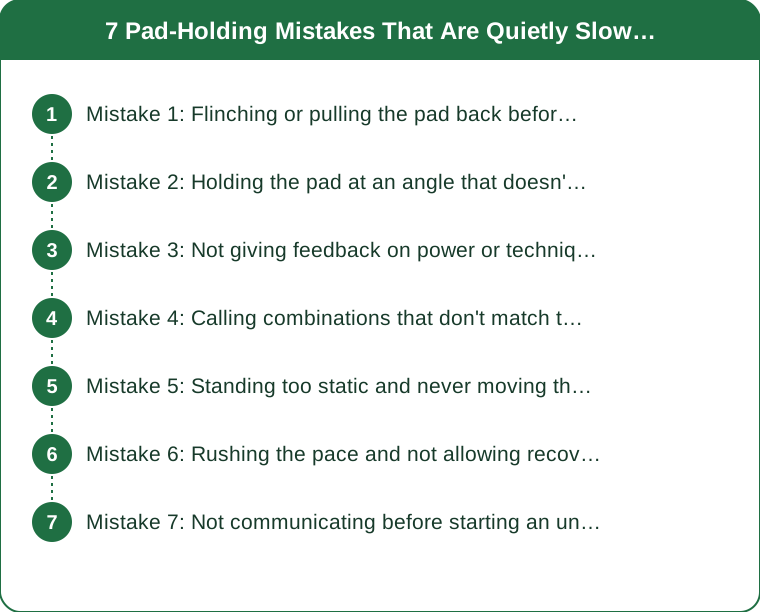
Mistake 1: Flinching or pulling the pad back before impact
Anticipating the strike and pulling back even slightly changes the actual target distance and timing your partner is training against, which can quietly build a habit of misjudging real distance against an opponent who won’t move predictably. Holding steady through the strike, rather than flinching, keeps the training realistic to what an actual opponent’s static guard would feel like.
Mistake 2: Holding the pad at an angle that doesn’t match a real target
Pads angled too flat, too high, or too far from a realistic body position teach a strike trajectory that won’t transfer well to an actual opponent’s stance. Matching pad angle and height to where a real target would actually be — a mid-torso angle for body kicks, a head-height angle for hooks — keeps the technique being trained genuinely applicable rather than pad-specific.
Mistake 3: Not giving feedback on power or technique between rounds
Silently holding pads round after round without commentary wastes a major opportunity, since the holder often has a clearer view of technique flaws (dropping the guard hand, telegraphing kicks) than the striker does in the moment. A brief note between combinations — ‘drop your hand after that jab’ or ‘good power on that last kick’ — meaningfully speeds up technical correction compared to pad rounds with no feedback at all.

Mistake 4: Calling combinations that don’t match the partner’s actual skill level
Calling advanced, fast combinations to a beginner (or overly simple ones to an advanced partner) mismatches the actual training stimulus needed. Reading the partner’s current skill level and adjusting combination complexity and pace accordingly gets more genuine improvement per round than running the same standard combination regardless of who’s on the other end of the pads.
Mistake 5: Standing too static and never moving the pads
Static pad holding trains strikes against a fixed target, which doesn’t build the ability to adjust to a moving opponent. Occasionally shifting position, angle, or stepping slightly during a combination — even a small amount — builds a partner’s ability to adjust mid-combination, which is a skill static pad holding alone doesn’t develop.
Mistake 6: Rushing the pace and not allowing recovery between hard rounds
Constantly pushing max pace without brief recovery windows within a round can push a partner into sloppy technique out of pure fatigue rather than actual skill-building. Reading fatigue signs and briefly slowing pace when technique starts breaking down (rather than continuing to call fast combos) protects the technical quality of the session, which matters more long-term than raw round volume.
Mistake 7: Not communicating before starting an unfamiliar combination
Calling out an unexpected or complex combination without a quick verbal heads-up can catch a partner off guard and lead to a fumbled, unsafe exchange rather than a clean rep. A brief verbal cue before an unfamiliar or advanced combination keeps both pad quality and safety intact, especially with less experienced training partners.
TL;DR:
- Flinching before impact and mismatched pad angles both train inaccurate distance and trajectory
- Silent pad rounds waste a real feedback opportunity the holder is uniquely positioned to give
- Matching combination complexity and pace to the partner’s actual skill level matters more than volume
- Occasional movement and recovery pacing build real adaptability, not just repetition
The fourth mistake surprises a lot of experienced pad holders — calling the same combination regardless of partner skill level undercuts more progress than most people realize.
Keep Reading
This article is for general informational and styling purposes only. Fit, sizing, and product availability may vary.