7 Muay Thai Sparring Mistakes That Keep Beginners Getting Hit
Quick Answer: The most common beginner sparring mistakes are dropping the guard after throwing a strike, squaring up instead of staying at an angle, and chasing power over timing — all three make you easier to read and easier to counter, regardless of how hard you can hit.
Pad work builds power. Sparring exposes exactly which habits fall apart the moment someone hits back.

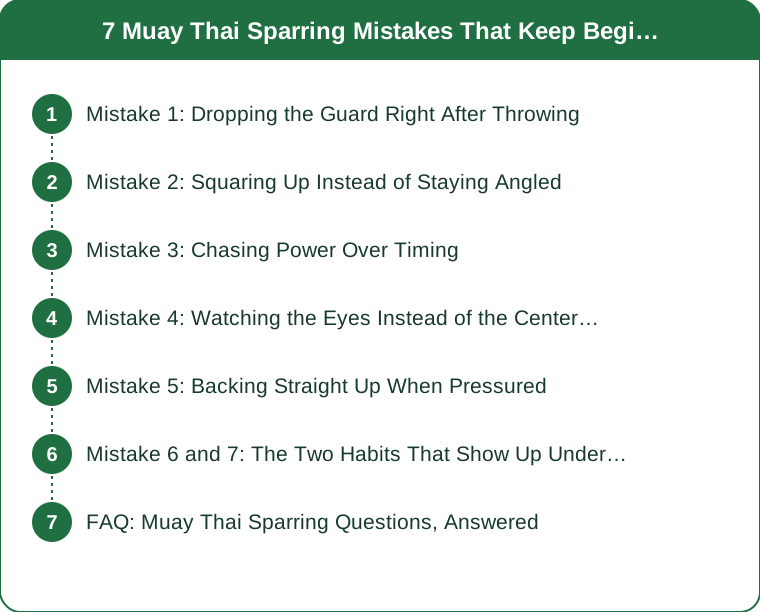
Mistake 1: Dropping the Guard Right After Throwing
The hand that just threw a strike is often the slowest to return to guard, leaving a clear window for a counter — this is one of the single most common ways beginners get caught in sparring.
Mistake 2: Squaring Up Instead of Staying Angled
Facing an opponent square-on exposes the maximum target area and removes the ability to check kicks efficiently — staying bladed at an angle reduces exposed target area and keeps the lead leg better positioned to check.
Mistake 3: Chasing Power Over Timing
A powerful strike thrown at the wrong moment is far less effective than a lighter strike thrown at the right one — beginners often prioritize hitting hard before they’ve built the timing sense to land cleanly in the first place.

Mistake 4: Watching the Eyes Instead of the Center Mass
Eyes are easy to fake with; hips and shoulders are not — reading center mass and hip rotation gives more reliable, earlier warning of an incoming strike than watching an opponent’s eyes or gloves.
Mistake 5: Backing Straight Up When Pressured
Retreating in a straight line keeps you directly in an opponent’s line of attack and often against the ropes or wall sooner than expected — angling off to the side while retreating is a safer habit to build early.
Mistake 6 and 7: The Two Habits That Show Up Under Fatigue
Mistake 6: Guard Drops as Rounds Get Tiring
Fatigue causes guard hands to drift down first, well before technique otherwise breaks down — deliberately checking hand position becomes more important, not less, as rounds progress.
Mistake 7: Trying to Win Every Exchange
Sparring isn’t a fight to win outright — treating every exchange as one to dominate leads to overcommitting and getting caught on the counter; trading a light touch for positional safety is often the smarter beginner habit.
FAQ: Muay Thai Sparring Questions, Answered
How long should a beginner do pad work before sparring?
Most gyms recommend several weeks to a few months of pad work and basic technique before light sparring, though this varies by gym and individual progress.
Is it normal to freeze up during early sparring rounds?
Yes — this is extremely common early on and typically fades with repeated, controlled sparring exposure rather than something to worry about.
Should sparring always be at full intensity?
No — most gyms use light, technical sparring for skill-building, reserving harder sparring for more experienced students under close supervision.
TL;DR:
- Guard drops right after throwing a strike are one of the most exploitable sparring habits
- Staying angled rather than squared up reduces exposed target area
- Timing beats raw power, and reading hips beats reading eyes
- Guard discipline under fatigue and not overcommitting to every exchange round out the list
None of these seven fixes require more power or speed — just more attention to habits that are invisible on pads but obvious the moment someone hits back.
Keep Reading
This article is for general informational and styling purposes only. Fit, sizing, and product availability may vary.