7 Muay Thai Clinch Mistakes That Make You Lose Every Exchange (And How to Fix Each One)
Quick Answer: Most clinch losses come down to posture, grip priority, and hip positioning rather than raw strength — fixing your head position, securing the dominant double-collar tie before your opponent does, and keeping hips back instead of leaning forward solves the majority of clinch problems beginners run into.
If you keep getting controlled or kneed in the clinch no matter how hard you train, the issue is very likely technique, not conditioning.

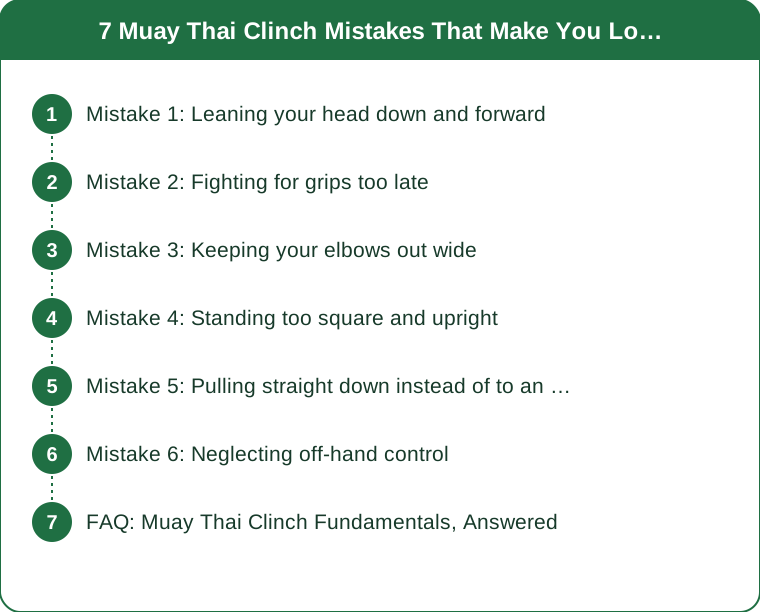
Mistake 1: Leaning your head down and forward
Dropping your head forward puts you off-balance and directly in range for knees. Keep your head up and slightly back, chin tucked, so your weight stays over your hips rather than pitching into your opponent’s strikes.
Mistake 2: Fighting for grips too late
Whoever secures the double-collar tie first usually controls the exchange. Beginners often wait to react instead of actively fighting for that grip the instant clinch range is entered — grip priority is a race, not a passive moment.
Mistake 3: Keeping your elbows out wide
Wide elbows open a direct path for your opponent to break your grip and land knees. Keeping elbows tucked closer to your frame protects your control and makes it harder for them to peel your hands off.

Mistake 4: Standing too square and upright
A square stance in the clinch gets easily off-balanced. Keeping a slight stagger stance with one leg back gives you a post to react from and makes you significantly harder to sweep or off-balance.
Mistake 5: Pulling straight down instead of to an angle
Pulling an opponent’s head straight down often just lets them recover balance quickly. Pulling to an angle, combined with a slight turn of your hips, actually breaks their base and opens a clean knee angle.
Mistake 6: Neglecting off-hand control
Beginners focus heavily on the collar tie while forgetting to control the opponent’s free hand or bicep, which lets that hand land strikes or fight for its own grip. Controlling both sides matters, not just the primary tie.
FAQ: Muay Thai Clinch Fundamentals, Answered
How long does it typically take to get comfortable in the clinch?
Most beginners need several months of consistent clinch-specific drilling before it starts feeling less chaotic and more controlled.
Is clinch strength mostly about raw physical strength?
Less than people assume — timing, positioning, and grip priority outweigh pure strength in most clinch exchanges, especially at beginner and intermediate levels.
Should beginners drill clinch separately from sparring?
Yes — isolated clinch-only rounds without striking let you focus purely on positioning and grips without the added pressure of incoming strikes.
TL;DR:
- Head position, grip priority, and hip posture cause most beginner clinch losses
- Fighting actively for the double-collar tie the instant clinch starts matters more than reacting
- Tucked elbows, a staggered stance, and angled pulls all protect your balance and control
- Controlling an opponent’s off-hand, not just the primary tie, closes a common gap
Keep Reading
This article is for general informational and styling purposes only. Fit, sizing, and product availability may vary.