7 Muay Thai Beginner Mistakes That Are Quietly Slowing Your Progress
Quick Answer: The most common beginner mistakes in Muay Thai are dropping the guard hand after throwing a strike, telegraphing kicks by looking at the target first, relying on arm strength instead of hip rotation for power, neglecting the check (defensive block) against leg kicks, rushing combinations before mastering single strikes, skipping conditioning specific to the sport, and ignoring corrections in favor of raw sparring reps — each one compounds the longer it goes uncorrected.
Progress in Muay Thai often stalls not from lack of effort, but from a handful of specific technical habits that quietly become harder to unlearn the longer they go unaddressed.

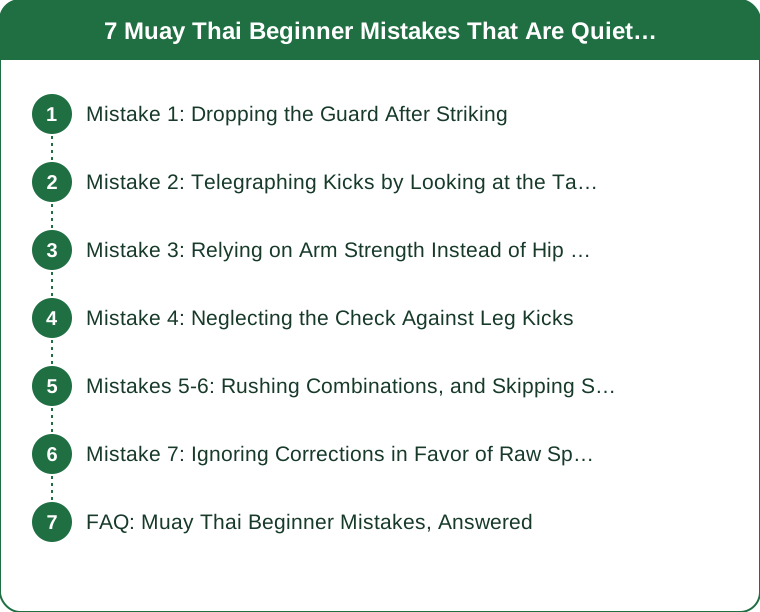
Mistake 1: Dropping the Guard After Striking
A common beginner habit is letting the guard hand drop immediately after throwing a punch or kick, leaving the face and body exposed to a counter. Consciously returning the hand to guard position immediately after every single strike, even in solo pad work, builds the habit before sparring makes the consequence real.
Mistake 2: Telegraphing Kicks by Looking at the Target
Glancing down at the target right before kicking gives an opponent a clear visual cue the strike is coming, cutting reaction time dramatically. Training to keep eyes level and use peripheral awareness for targeting takes deliberate, repeated correction to override the natural instinct to look.
Mistake 3: Relying on Arm Strength Instead of Hip Rotation
Punching or kicking primarily with arm or leg muscle, without rotating the hips into the strike, caps power output well below what proper mechanics generate. Hip rotation is where the majority of real striking power actually originates — arm strength alone is a limited, exhausting substitute.

Mistake 4: Neglecting the Check Against Leg Kicks
Failing to check (block with the shin) incoming leg kicks consistently leads to painful, avoidable impact directly on the thigh muscle. This defensive skill needs deliberate, repeated drilling specifically — it doesn’t develop naturally just from sparring more.
Mistakes 5-6: Rushing Combinations, and Skipping Sport-Specific Conditioning
Mistake 5: Rushing into combinations before mastering single strikes
Moving to multi-strike combinations before a single jab or kick has solid mechanics compounds small technical flaws across every strike in the combination, making them harder to isolate and correct later.
Mistake 6: Skipping sport-specific conditioning
General fitness doesn’t fully prepare the shins, forearms, and specific muscle groups Muay Thai uniquely stresses — dedicated conditioning (shin conditioning drills, clinch-specific strength work) closes a gap general gym training leaves open.
Mistake 7: Ignoring Corrections in Favor of Raw Sparring Reps
Prioritizing sparring volume over absorbing coach corrections on fundamentals often feels like faster progress, but tends to ingrain compensations for the same flaws sparring after sparring. Slowing down to actually implement pad-work corrections before returning to sparring produces faster long-term improvement, even though it feels slower in the moment.
FAQ: Muay Thai Beginner Mistakes, Answered
How long does it typically take to break a habit like dropping the guard?
Most beginners need several weeks of conscious, repeated correction across every training session before it becomes automatic.
Should beginners spar right away, or focus on technique first?
Most coaches recommend a solid technical foundation, generally a few months, before regular sparring to avoid ingraining bad habits under pressure.
Is shin conditioning something that happens naturally through training, or does it need dedicated work?
It develops gradually through consistent pad and bag work over time, though dedicated conditioning drills speed up the adaptation process.
TL;DR:
- Dropping the guard and telegraphing kicks are the two most common early technical leaks
- Real striking power comes from hip rotation, not arm or leg muscle alone
- Checking leg kicks and sport-specific conditioning both need dedicated, deliberate drilling
- Absorbing corrections before adding sparring volume speeds up long-term progress
None of these seven require more raw training time to fix — just more deliberate attention to the specific habit each one represents.
Keep Reading
This article is for general informational and styling purposes only. Fit, sizing, and product availability may vary.