6 Signs Your Teep Is Being Read Before You Throw It
Quick Answer: A teep gets read when your weight shifts back before you throw, your hands drop, your chambering knee rises too high, your rhythm becomes predictable, you always throw from the same range, or your eyes go to the target. Fix the weight shift first — it is the earliest and most visible tell, and it precedes everything else.
Your teep used to work. Now it gets caught, swept, or countered with a right hand more often than it lands clean.
The technique itself is probably fine. What has happened is that the setup became readable, and an opponent who knows it is coming has an enormous advantage against a kick that commits your weight to one leg.
Here are the six tells, roughly in the order that people develop them.

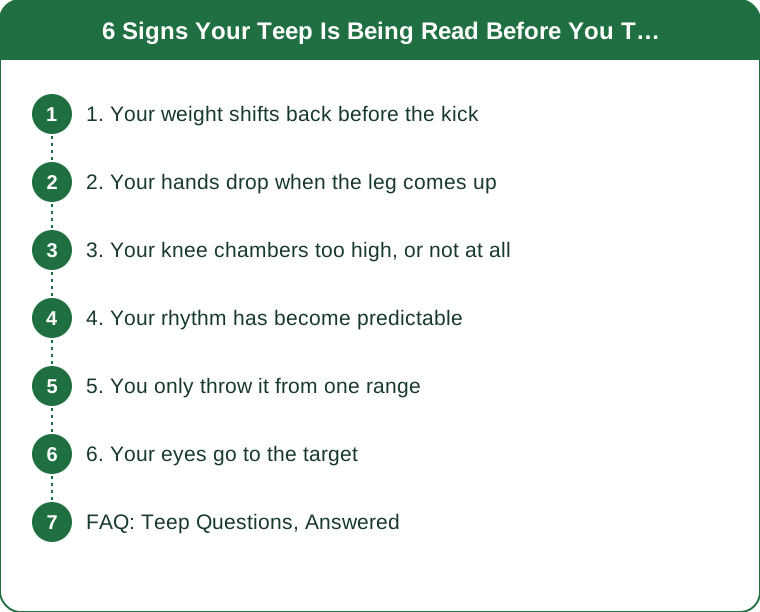
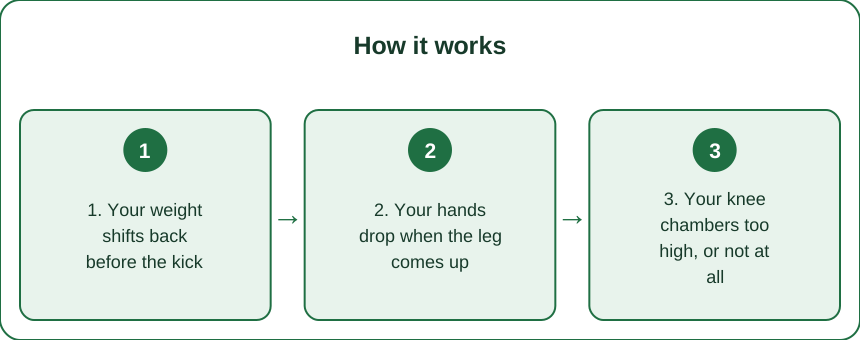
1. Your weight shifts back before the kick
This is the earliest tell and the most common one.
To teep, you need weight on the rear leg. Many fighters load that shift as a distinct preparatory movement — a small settle backward — and then kick. That settle is visible from across the ring and it happens a full beat before anything else.
An experienced opponent does not watch your leg. They watch your center of mass. The moment it moves back, they know.
The fix:
- Kick from where you already are. The teep should launch from a neutral stance without preparation. If you cannot throw it without loading, your stance is too square or your weight is too far forward at rest.
- Practice the no-load teep on the bag. Stand neutral, throw without any preparatory shift, at half power. Power comes later. Right now you are training the absence of the tell.
- Film yourself from the side. The shift is nearly impossible to feel and completely obvious on video. Two minutes of footage will show you exactly how big your load is.
Get this one and several of the others improve automatically, because the load is what triggers the compensations below.
2. Your hands drop when the leg comes up
Almost universal, and it is what makes the counter available rather than the kick readable.
As the knee chambers, most people’s hands drift down — sometimes a few inches, sometimes to the chest. It happens because the arm and leg on the same side are neurologically linked, and because the balance adjustment recruits the arms.
The consequence is not that the opponent sees the kick coming. It is that when they catch or evade it, your head is unprotected, and that is where the counter right hand lands.
Corrections:
- Actively press the lead hand forward as the knee comes up. Not just holding it — pushing it toward the opponent. This also creates useful distance measurement.
- The rear hand stays glued to the jaw. Full stop. Non-negotiable.
- Shadowbox teeps in front of a mirror watching only your hands, not your leg. Ten minutes of that rewires it faster than a month of bag work where you are watching the bag.
A teep with dropped hands is not a strike, it is an invitation. Getting this right is the difference between a kick that costs the opponent something and one that costs you.
3. Your knee chambers too high, or not at all
Both extremes are readable, and each fails differently.
Too high — chambering to a full knee strike position before extending — announces the kick a beat early and makes it slow. It also makes the leg easier to catch, because the extension is long and predictable.
Too low — pushing the leg out without any chamber — produces a weak kick with no snap that gets swept easily because the foot travels in a visible arc rather than a straight line.
The functional chamber is modest: knee rises to roughly hip height, foot pulled back under, then the hip drives forward and the leg extends. The kick travels in a straight line from that position.
Two useful checks:
- The path should be straight, like a jab with your foot. If your foot arcs upward into the target, the chamber is wrong.
- The retraction should be as fast as the extension. A teep that hangs out there after landing is what gets caught. Snap it back to chamber, then set down.
Drill it slowly against a wall at kicking distance. The wall stops the extension and forces you to focus entirely on the chamber and the retraction, which is where the actual problem lives.

4. Your rhythm has become predictable
You throw the teep at the same point in your combinations every time, and everyone has noticed.
Common readable patterns:
- Always after the jab. Jab, teep, jab, teep. Effective the first two rounds, free counter after that.
- Always as a range reset when the opponent presses. If your teep only appears when you are being pushed back, it is completely predictable.
- Always on the same count within a combination — third strike, every time.
Rhythm is what advanced opponents actually read, not individual technique. You can have a flawless teep and still get countered every time if it arrives on schedule.
Breaking it:
- Throw the teep first, cold, with no setup, at unexpected moments.
- Fake it and follow with a hand strike. Once they respect the teep, the fake becomes more valuable than the kick.
- Vary the target. Lead leg, thigh, hip, body, face. Different targets from the same motion make the intent unreadable.
- Change the count deliberately in sparring — force yourself to throw it as the first or fourth strike rather than the second.
5. You only throw it from one range
If your teep appears exclusively at long range, closing distance turns it off entirely — and any opponent who has watched one round knows to close.
The teep is functional across more range than most people use it. The short teep, thrown at close range as a hip or thigh push, is one of the most useful tools in muay thai and almost nobody drills it.
Range variations worth developing:
- Long teep to the face or chest. The classic, and the one everyone practices.
- Mid-range teep to the stomach as an interruption when they load a kick.
- Short teep to the hip or thigh at close range to break clinch entry. Barely a kick — more of a shove with your foot — and extremely effective at disrupting forward pressure.
- Rear-leg versus lead-leg teep. Most people heavily favor one. Developing both roughly halves how readable you are.
Drill: three minutes on the bag throwing only short teeps from a range where you feel too close to kick. It is awkward for the first minute and useful forever after.
6. Your eyes go to the target
The last tell and the hardest to fix, because it is entirely unconscious.
Looking at the body before kicking the body, or glancing down before a low teep, is a tell that skilled opponents pick up without consciously articulating it. Eye movement precedes technique by a fraction of a second, and at high levels that is enough.
The fix is a general skill rather than a teep-specific one:
- Soft focus on the opponent’s chest or upper sternum. From there peripheral vision covers both hands and both legs. This is the standard and it takes weeks to become natural.
- Never look where you are about to strike. Practice this in shadowboxing where there is no pressure to reinforce the old habit.
- Have a training partner call out your tells during light sparring. Partners see things you cannot, and eye movement is one of the easiest for them to spot.
Of all six items here, this is the one to work on last — the first five produce larger returns and are easier to correct. But if you have fixed the other five and the teep still gets read, this is where it is coming from.
This is general information, not coaching instruction. Work technique changes with a qualified instructor who can see what you are actually doing.
FAQ: Teep Questions, Answered
Why does my teep keep getting caught?
Usually slow retraction combined with over-extension. The kick lands and the leg stays out for a beat. Drill snapping back to chamber before setting down, and shorten the extension slightly — a teep that lands at 80 percent extension is much harder to catch than one at full reach.
Should I use the lead or rear leg teep more?
Both, deliberately. The lead teep is faster and better for range control and interruption; the rear teep is more powerful and better for pushing someone back. Fighters who only have one are considerably easier to read.
How long does it take to fix a telegraphing habit?
The weight shift usually takes two to four weeks of deliberate drilling to substantially reduce. Eye habits take longer, often several months. Filming yourself every couple of weeks is the fastest way to know whether it is actually changing.
TL;DR:
- The preparatory weight shift is the earliest and most visible tell. Fix it first.
- Hands dropping does not reveal the kick — it makes the counter available. Press the lead hand forward.
- Chamber to about hip height, extend straight, and retract as fast as you extended.
- Rhythm is what advanced opponents actually read. Vary count, target, and setup.
- Develop the short teep. Only having a long-range version means closing distance disables you.
Film two rounds from the side. Most people find their number one tell within the first thirty seconds of footage, and it is almost always something they had no idea they were doing.
Keep Reading
This article is for general informational and styling purposes only. Fit, sizing, and product availability may vary.